Not the same story as the other two, but inspired by the same idea.
Once, there lived a princess who was also a witch. She make her land perpetually prosperous and well fed. For reasons of her magic, she could not marry without love, even when her parents died, leaving the kingdom without heirs and without the respect her parents had drawn. Many armies came to take the lovely kingdom, so the witch-queen drew up a thick and thorny bush about her home. When the armies failed, the kingdoms began to send princes and other nobles from their lands, to win her heart.
From her room in the highest tower, she would challenge each suitor to make their way through the thorny bushes, where just-slashed thorns would grow back as soon as one entered, striking through armor and skin. None could defeat her magics.
One day, a young man rode up to the bush nearest her tower. "Hail, Witch-Queen."
"Hail, traveler," the witch-queen said, coming to her window. "Are you here to present a suit?"
"No, Your Majesty. I merely wished to meet one as strong in will and magic as yourself."
She nodded, a large enough gesture to be seen from the top of her tower. "So you have done." Many nobles took great offense at such replies, and it was a simple enough way to have fewer fertilizing her briar and more protecting their people.
The man grinned widely enough for the witch-queen to see it from her tower. "I would know you better than an exchange of hellos. I have some magics of my own, and I am in need of a tutor. Whoever taught you must be a fine teacher indeed."
"I taught myself."
"Then you are more powerful than any tale has told me."
And the witch-queen granted him some of his wish, for it is bad luck to turn away a traveler, and because a fellow mage interested her.
Soon enough, the witch-queen allowed the man within the thorny bushes, though when the witch-queen slept, the young man stayed in a room which locked from the outside. Friend or not, the man was indeed versed in the craft, and gaining new talent each day.
"May I not sleep somewhere more comfortable?" The man asked after dinner, in his eighth or ninth month in the witch-queen's palace.
"You may choose any chambers in the castle, though I shall place a lock on any chambers you choose." The man was no noble after her heart for a prize, and anything else was irrelevant.
The man smiled. "I may choose any chambers in the castle?"
The witch-queen nodded. "Should a servant wish to not share a room with you, they could always move."The witch-queen did not say, but thought, If you wished to do one harm, you would not need to enter their chambers.
"There is one room I enjoy, I admit." The man smiled in a way that made something twist in the witch-queen's gut. "I quite enjoy the view from the room atop the highest tower in this palace."
The witch-queen's eyebrows rose, and then she laughed.
"As I have given my word, so shall it be. You may move in a week, when the smith has made an appropriate lock, and I have spelled it as I need."
The man rose from the empty table. "Thank you, Your Majesty." He said with a smile and a deep bow.
By the next week, they shared chambers, though not a bed. Because it was most convenient, their lessons gradually moved to before breakfast and after dinner, when the subjects petitioning the witch-queen were in their beds, and even the bravest of suitors would not enter the thorny bushes.
"How did you learn all this on your own?" the man asked as they settled for the evening.
The witch-queen looked at him, considering. Then she said, "Magic is simple to do on oneself."
He nodded.
"The ruler is the land. The magic you know me so versed in is magic of the land. Every spell I cast, I cast on myself." They remained quiet for a time after that, and the witch-queen knew that there would be no more lessons discussed that evening. She dimmed the lamp.
"What does that do to you?"
"Hm?"
"You are the land. You drew up a great wall of thorns to protect you home. I may not know as much magic as you know, Your Majesty, but I know enough."
The witch-queen shrugged. "I became what my people needed, as the land did. I could only wed one whom I loved, but I promised my mother and father that I would marry if I could." She stared at the ceiling. She'd never told anyone that. "I could not be marrying the first man who came along. I put up thorns against armies, and thorns against suitors."
There was a silence long enough for the witch-queen to believe the man had fallen asleep before he said, "You parted the thorns for one."
The witch-queen glanced at him, his eyes bright and keen in the moonlight. She remembered what she had learned of him: that he was clever, quick to learn, and kind to her and to her subjects. And, though he had not been handsome when they first met and his appearance had never changed, she found herself thinking him quite handsome now.
"A kind stranger who asked for entrance, rather than demanding it as a right. Yes."
"And who counts himself blessed to have gotten as far as he has." He smiled. The witch-queen thought, Oh. That's what that is.
"I love you," she said, tasting words that she hadn't used since her parents' death.
"I love you, too." Odd to hear him say it second. He had declared his love ages ago; she had simply ignored his heart as she ignored the other suitors'.
"And had I not?"
"Then I would have a wonderful teacher and a better friend than most could find in several lifetimes." He paused. His brow furrowed. "Do I ask you to marry me, or do I ask you to ask me?"
"I will be sure to look it up later, and then we shall both say that the correct person asked." The witch-queen nodded to herself. "I always wanted to wed at midsummer, when I was a child."
The king-to-be grinned widely. "That sounds wonderful."
The witch-queen kept her powers, and at midsummer gained a witch-king. The thorny bushes about her kingdom remained, and every summer, from that day to this, bright roses bloomed upon them.
Tuesday, July 31, 2012


Thursday, July 26, 2012
Witch-Queen (Woman)
QueenThere are many ways to spin a tale.
...
However, neither witch nor woman nor queen was content to leave it at that. Her kingdom needed an heir.
The witch-queen knew romantic love, or what it was supposed to be. She also knew that she had not felt it. Sex held little interest for her, and though she knew that was what pure and innocent women were supposed to say, she also knew that most women didn't mean it.
But the geas had never mentioned sex, simply love. The witch-queen knew of love. She sent out a new challenge: one of cleverness and charm.
The first test was to find the messenger, the second to politely ask for the password to gain entrance to her kingdom. Since the witch-queen chose the servants she sent, three suitors made it past.
The man from the south was golden as the sun, from his hair to his skin to his tawny eyes, and as outspoken as one would expect. The northeasterner was dark and quiet as the night: deep colors to his skin and hair, deep and quiet thoughts behind his eyes. The northwestern man was starlight itself, true blond hair, eyes silver and skin a few shades away from it.
The sunny one was charming, but cared little for non-social pursuits. The dark man was quiet, but polite, and opened up like a moon flower if one spoke to him without forcing him into small talk. Dear starlight was the only one everyone seemed to get along with happily, for he could sit in perfect silence and read, or he could chatter for hours on end. The witch-queen took to thinking of him as a mirror, reflecting whatever his conversational partner wanted. When she asked him his favorite book, he responded with hers. If the dark man asked the same question, the northwestern man chose a title that made his eastern neighbor smile, and when the sunny one asked, he grinned and said, "Oh, I don't care for reading; I'd much rather spar."
When the sun grew tired of being stuck in one place for so long, the witch-queen gave him passage back to his kingdom. When the night had grown bored of every book in the palace, she let him go as well. "You've won by default, it seems, mirror."
He looked at her, eyebrows drawn up. "No. I would win if you loved me." Mirror spread his hands. "Those were the terms, and I abide by them."
The witch-queen looked at him. "Have you ever loved someone, in the way people expect?"
"I am everything one expects, Your Majesty." But he smiled as if he hid something.
"That sounds tremendously shallow of you."
The man raised his eyebrows, the first surprised gesture he'd made over his entire visit. "I have never felt a particular affection for the flesh," he admitted. The witch-queen thought of other reflective things. The deepest lakes and streams could reflect perfectly, on a still day, but shake them the right way, or look past your reflection, and suddenly you see life and rocks of every color and breed, all the way down...
"But?" she asked.
"I am like you, Your Majesty." That moment, when you've looked past your reflection for so long, and someone swims beneath you. "One does not need to want physical touch to love."
The witch-queen sat, and gestured for her mirror to do the same. "We would need to, if we married," she said simply. "Personal desires aside, I am a queen, and I shall need heirs."
"Does that mean you love me, then? Since bastard heirs are generally frowned upon." He smiled.
"You are as attentive as I am. You know I do."
His smile turned into a grin. "It is traditional to say it, Your Majesty. Like this: I love you. I want to marry you and raise children with you."
The witch-queen smiled back. "I love you, too. I've been envisioning us married in spring, and eventually raising children who learn to walk among wildflowers, and little else makes me so happy as to think of being married to someone clever enough to play the game of courts against me." She raised an eyebrow. "Sufficient?"
"Well, this is never going to be boring," he laughed.
"Oh, I hope not. T'would be dreadful to misjudge you so horribly."
Friday, July 20, 2012
Witch-Queen (Queen)
Once, there was a clever princess who was also a very powerful witch. She could make buds bloom, flowers fruit, and heal the unhealthy. While her mother and father were young yet, she was a blessing upon the land.
As is the way of things, her power came at a price. Should she marry and not love her partner, her powers would disappear, and what she had healed would rot with her magic. An odd price, certainly, but it was the rule her magic gave her. Had she not been a princess, this might have been fairly simple. But then, if this geas were simple, the magic doubtless would have chosen another one. Such is the way of things.
At first, this rule was a small annoyance. As a girl, the princess could help far more than most her age, and took well enough to etiquette and diplomacy to endear herself to those who might otherwise become jealous. A younger sibling could always marry for political reasons. Odd though it might be for a younger to marry before the eldest, anyone would understand. Her mother and father had their daughter in the first year of their marriage, and so all believed another child would come swiftly. They believed this in the first year, and the second.
On the princess's sixteenth birthday, none believed there would be another child.
Suitors had always courted the lovely princess--those brave enough to approach a witch, and confident enough to believe they could win her heart. Noble after noble approached the princess, all foolish and arrogant. Many understood how to play the game, but the princess played it better than they did. She saw their lies, and saw all of them for what they were: poor liars, immature tricksters. She could perhaps love one who could play the court as she did, but never one who thought her less than she was. Everyone who approached her underestimated her.
One day, she awoke to find that her parents lay dead in their bed, still holding each other. The princess-now-queen knew what was coming then, and come it did: armies upon armies. Her kingdom had been prosperous for decades under her care, and blessed even before that. Even split between her three neighboring kingdoms, her kingdom would be a bounty, and they knew she would not let it die. Though it would have been easier, there was no reason for one to marry her to gain the kingdom. They would simply attack it.
The princess had only ever healed and brought bounty to her land, so it was little wonder that no one thought of what else powers of growth could do.
Around her kingdom she drew up thick, thorny bushes, as tall as a score of men and at least as deep as three at any place. As a show of her confidence, she had three palaces built, facing each of the three attacking kingdoms. In summer, she lived in the central palace where her mother and father raised her, in fall, she moved Northwest of it, in winter, South, and in spring, Northeast. In each palace, her bedroom was in the tallest tower, a boast and a challenge to any who would attack her home.
The queen was willing to give her life to her kingdom, as any good ruler would, and give it she would, however long or short it might be.
...
As is the way of things, her power came at a price. Should she marry and not love her partner, her powers would disappear, and what she had healed would rot with her magic. An odd price, certainly, but it was the rule her magic gave her. Had she not been a princess, this might have been fairly simple. But then, if this geas were simple, the magic doubtless would have chosen another one. Such is the way of things.
At first, this rule was a small annoyance. As a girl, the princess could help far more than most her age, and took well enough to etiquette and diplomacy to endear herself to those who might otherwise become jealous. A younger sibling could always marry for political reasons. Odd though it might be for a younger to marry before the eldest, anyone would understand. Her mother and father had their daughter in the first year of their marriage, and so all believed another child would come swiftly. They believed this in the first year, and the second.
On the princess's sixteenth birthday, none believed there would be another child.
Suitors had always courted the lovely princess--those brave enough to approach a witch, and confident enough to believe they could win her heart. Noble after noble approached the princess, all foolish and arrogant. Many understood how to play the game, but the princess played it better than they did. She saw their lies, and saw all of them for what they were: poor liars, immature tricksters. She could perhaps love one who could play the court as she did, but never one who thought her less than she was. Everyone who approached her underestimated her.
One day, she awoke to find that her parents lay dead in their bed, still holding each other. The princess-now-queen knew what was coming then, and come it did: armies upon armies. Her kingdom had been prosperous for decades under her care, and blessed even before that. Even split between her three neighboring kingdoms, her kingdom would be a bounty, and they knew she would not let it die. Though it would have been easier, there was no reason for one to marry her to gain the kingdom. They would simply attack it.
The princess had only ever healed and brought bounty to her land, so it was little wonder that no one thought of what else powers of growth could do.
Around her kingdom she drew up thick, thorny bushes, as tall as a score of men and at least as deep as three at any place. As a show of her confidence, she had three palaces built, facing each of the three attacking kingdoms. In summer, she lived in the central palace where her mother and father raised her, in fall, she moved Northwest of it, in winter, South, and in spring, Northeast. In each palace, her bedroom was in the tallest tower, a boast and a challenge to any who would attack her home.
The queen was willing to give her life to her kingdom, as any good ruler would, and give it she would, however long or short it might be.
...
Friday, July 13, 2012
Outside
There’s a glass dome.
Inside the dome, there lies a beautiful place. We can see it through any screen. There, people are normal. They are all quite similar, and all fairly happy. They are sometimes hurt, in the ways we are hurt, but there are ways that we are hurt that they do not have to worry about, and ways we are commonly hurt that they rarely are.
Sometimes people inside the dome give me odd looks. “Well, if you don’t like it outside there, why don’t you just come in?” Occasionally, others understand a bit better. “You could pass, if you just did your hair differently. Why don’t you?” Some understand better still, and stand near the edge—even come outside. They don’t understand perfectly, but they understand that they don’t understand. That means a lot.
One day, while chatting with Jordan on our opposite sides of the dome, I saw something glittering on her side. “What’s that?”
"What?" Jordan turned her head, then looked back to me with a grimace. “Ah. That’s the dome.”
I furrowed my brow. “But this is the dome.”
Jordan shook her head. “This dome is easy to move through, so we call it the gauzy dome. That dome”—she nodded her head—“is impossible to get through.” She rolled her eyes. “They just say we’re not trying hard enough.”
I opened my mouth, then closed it. I couldn’t think of a polite way to say, You do the same thing, so I just said, “Thank you.”
A thought had occurred to me, and one I thought important. I set out to test it. I walked for months, stopping wherever I thought I saw something.
I was right. There were other domes—I saw dozens. Some of them had other domes in them, like the one I’d grown up closest to. It was obvious, once I was looking. Some touched other domes, and being in either seemed to make it easier to go to the other.
Then I came to a very large one. It was peculiar enough that I hardly recognized it as a dome at first. Every dome I had come across arched away easily, like someone had taken a half-sphere and planted it in the ground, to grow and shrink as necessary. This one was different. It arched toward me, not away, and the material was lighter and somewhat opaque, more like gauze than glass.
I went still.
Then, very slowly, I craned my head back. It arched up and over, in a perfect line that kept me separate from…well. Them.
It’s always ‘them’, isn’t it?
Inside the dome, there lies a beautiful place. We can see it through any screen. There, people are normal. They are all quite similar, and all fairly happy. They are sometimes hurt, in the ways we are hurt, but there are ways that we are hurt that they do not have to worry about, and ways we are commonly hurt that they rarely are.
Sometimes people inside the dome give me odd looks. “Well, if you don’t like it outside there, why don’t you just come in?” Occasionally, others understand a bit better. “You could pass, if you just did your hair differently. Why don’t you?” Some understand better still, and stand near the edge—even come outside. They don’t understand perfectly, but they understand that they don’t understand. That means a lot.
One day, while chatting with Jordan on our opposite sides of the dome, I saw something glittering on her side. “What’s that?”
"What?" Jordan turned her head, then looked back to me with a grimace. “Ah. That’s the dome.”
I furrowed my brow. “But this is the dome.”
Jordan shook her head. “This dome is easy to move through, so we call it the gauzy dome. That dome”—she nodded her head—“is impossible to get through.” She rolled her eyes. “They just say we’re not trying hard enough.”
I opened my mouth, then closed it. I couldn’t think of a polite way to say, You do the same thing, so I just said, “Thank you.”
A thought had occurred to me, and one I thought important. I set out to test it. I walked for months, stopping wherever I thought I saw something.
I was right. There were other domes—I saw dozens. Some of them had other domes in them, like the one I’d grown up closest to. It was obvious, once I was looking. Some touched other domes, and being in either seemed to make it easier to go to the other.
Then I came to a very large one. It was peculiar enough that I hardly recognized it as a dome at first. Every dome I had come across arched away easily, like someone had taken a half-sphere and planted it in the ground, to grow and shrink as necessary. This one was different. It arched toward me, not away, and the material was lighter and somewhat opaque, more like gauze than glass.
I went still.
Then, very slowly, I craned my head back. It arched up and over, in a perfect line that kept me separate from…well. Them.
It’s always ‘them’, isn’t it?
Sunday, July 8, 2012
Summer and Winter
There are many tales of the seasons, and of how the gods brought them into being. Some of them are even true.
“Winter, dear, hurry up!” Summer called over her shoulder, green skirts swishing over skin the color of fertile earth, under hair like fresh grain. “It’s nearly time.”
“Sunset isn’t for some minutes yet, Summer,” Winter said. Winter had been as young as Summer, some months ago. His hair had been true blonde, his skin as pale and smooth as ice, his eyes a blue or a purple so pale as to be nearly white. Winter was pale yet, but a wan pale now, rather than a youthful one. Gray hair, rougher skin, failing eyes.
Summer laughed and ran back to him. “I know. But the sooner you get there, the sooner you can rest, and the better you’ll feel next long night. Look at me: I was there nearly an hour early, and I feel fantastic!”
“You’ve only just woken,” Winter chuckled as Summer nearly danced around him, “of course you feel fantastic.”
Summer helped Winter to his place of rest, an oddly tall peak for the area, where he would rest for the next few months, as Summer had rested in her spring when her hair had been dull and her feet heavy. “Rest well, dear friend.”
“Thank you, Summer,” he murmured, then yawned. “See you around even night?”
“Of course.” She sat by him until the sun touched the horizon, then stood.
With Winter resting, there would be fewer flowers, more fruit. It was an energetic time of her life, and a draining one. An exciting one.
Summer strode out to greet the new younglings.
“Come on, Summer,” Winter said quietly. “Almost there.”
Summer had faded. Her hair was the white of age now, rather than the lively corn-blond it had been early in her season. Her skin was still the deep color of fertile soil, but it had less shine in it, and had roughened some.
From a distance, Winter might look the same. He was pale, his hair was pale, and his irises were the palest one could have without all but the pupil being white. But, for all his pallor and quiet, he was as strong at his height as Summer was at hers. Burning or freezing feels the same. Everything else is a matter of personal preference.
“I did more than I should have, I think,” Summer mumbled.
“It’s fine. Rest now. Come on, there you go.” He took her arm and led her into the hot spring.
“See you spring’s even night, mm?” Summer asked drowsily.
“Yeah. Of course.”
Summer safely deposited, Winter went out to the land. The trees welcomed him already, with bright leaves and a satisfying crunch under his feet. The animals were quieter, but no less clear: a hundred hundred breaths moving air to the same beat. Trees abscising, animals resting, Summer settled…there was only one thing left, to make the land truly Winter’s.
He made it snow.
Tuesday, July 3, 2012
Knowledge
There are facets to everything.
Some people talk about two sides to the same coin. That’s true, as far as it goes. Male and female; good and evil; black and white; up and down. But, the closer one looks, the harder it is to be a coin, the easier to be a spectrum, or a jewel. Genderqueer; well-meant harm and accidental help; gray; sideways or counterclockwise.
There’s an old story. The stories that survive that long must be important, mustn’t they? If the Book of Kells were just another story, it would be lost. We lose so many important ones, oh dear Alexandrian library, how could anything unimportant remain?
But then, what could be unimportant?
The story begins with paradise, where another provides all food and shelter, where bodies are not yet sexual, nor shameful. Then a man gives birth to the first woman, donating a bone, a deep part of himself, just as a woman risks her life and health in any normal pregnancy. The paradise remains—this birth is odd, to us, but no sin.
(Father did it; Father can do no wrong.)
The great provider, the one who gives shelter from the outside and keeps food in this home, makes one rule. Though there are many sources of food, many fruit trees, there is one they may not eat of. It is poison, if they eat it they shall die.
Then, a snake—as in any story, intelligent, and as is common, a force opposed to the order of things. Any creature who is always bright and usually chaotic will often be trickster, as this one may be.
Try the fruit of the tree. No ill will come. Try it.
(The snake appears to be of paradise. What reason had she to distrust it? What reason had she to trust it over Father?)
She takes a bite, and has an epiphany, or the reverse of one. A realization of self, a recognition of body. She covers herself, and goes to the man whose rib was the first part of her to exist.
(She is of paradise. What reason had he to distrust her? What reason had he to trust her over Father?)
He eats of the tree, and has the same inverse-epiphany, or so close as to appear identical. He sees why she covered herself, and covers himself.
The provider sees that they have covered themselves, sees that they have eaten of the tree, casts them from paradise. Casts them into where they must work for their own food, out of Father’s house.
Some call this Original Sin. Indeed, it is the first time any broke a rule.
Others question. The tree was a Tree of Knowledge. They were curious, without experience, without knowledge. How could they have done anything else? Father was wrong to expect different
Others say it isn’t wicked, or good, but another facet on the same jewel. The boy and girl needed to grow into the first man and woman. The woman ate first, as girls mature more quickly than boys. She gifted him knowledge, as a member of the tribe would initiate another into the world of the adult. The questioners are right, Father paved the way, but not to bad. Simply to the next thing that would happen.
Regardless. They were forbidden the tree, and ate of it. They grew more capable, and had to work on their own. Such is the way of the world.
Friday, June 29, 2012
Transformation
The first step is fake. Or, at least, done from expectation rather than compulsion. The brew takes some time to take effect, as I noticed the first time I took it, when I didn’t know what to expect. Those around me think it simply becomes easier to slip between. As far as I can tell, the reverse is true.
Though maybe I’m wrong. Maybe it just feels so natural, now, that I can do it whenever I please, so after drinking it I feel no different. I feel as though I can be the same as the first time, whenever I choose to, and perhaps only when I choose to, drink or no.
But the first time I drank…I still remember that.
I expected nothing. They hadn’t told me anything, except that it would make me a better warrior. It smelled of alcohol, and something else. I thought little of it. Courage. Others started growling, and I thought, That’s an interesting part of the culture. Becoming closer to animals, when they were about to start a fight. It made sense—they slept closer to their dogs than the tribe that had taken me before this one, and their dogs were closer to wolves than any I had ever seen.
A few started up a howl, and the others ran after them as one. I noticed that I was following, then I stumbled. A warrior to my right caught me, nudged me up, jerked her muzzle toward the front. Follow.
From there, it was…red and black, impacts and silence and growls.
The next morning, I woke up by the river, amidst a pile of my tribe and our furs.
My memories of that battled have never become clearer, but they have never faded. I cannot tell you the face of any I fought, any I saved, any who saved me, but I can still hear the howls, growls, and snarls.
Friday, June 22, 2012
Companion
There’s a rule.
There are many things people call rules, where Harriet works. Don’t kill; don’t forget; don’t be obvious. But they’re all guidelines. Any book in which they’re written has without a good reason written after in white ink and in a very small font. Any conversation where such a rule is spoken, without a good reason hangs unspoken between the interlocutors’ eyes.
But there is a rule, one rule, for those who guard what needs guarding. One who knows each world, and knows enough to know that (nearly) everything is worth protecting.
The rule is simple: Never get attached.
The rule is simple, except when it isn’t.
She reached her hand through the hole in the wooden fence. Her hand met another hand, very smooth, smoother than the day before. Manicured, Harriet guessed.
“Hello, lovely.” Neither knew the other’s name, the other’s face—safer that way hangs in the air, between every word they speak—but Harriet knows this woman well enough to know her lovely. “Relaxing day?”
The other woman’s hand shifted in a way that meant a smile. “Yes. Beautiful day at the spa. You’d’ve hated it.”
Harriet laughed. The other woman could get Harriet to laugh; that would be enough to earn lovely on its own.
They spoke for longer, of many things. The evening was beautiful, as long as it lasted. Their date night always one of challenges and achievements and wonder and lips brushing gently over knuckles.
Harriet broke first, as she always did, when she stopped thinking, What a bright mind; what a lovely voice, what expressive hands, and started thinking, A woman with exactly this shade of skin, with enough money to pay for a spa day, but at a job that lets her hands run as rough as she feels like, that needs neither calluses for practicality nor smooth skin for perfect appearance—
Harriet stood, suddenly. “I should go.” She said that a little differently each time, but their last words, never spoken, were always the same.
I’m sorry. I can’t figure out who you are. If they ask, I can’t know you well enough to answer.
There are many things people call rules, where Harriet works. Don’t kill; don’t forget; don’t be obvious. But they’re all guidelines. Any book in which they’re written has without a good reason written after in white ink and in a very small font. Any conversation where such a rule is spoken, without a good reason hangs unspoken between the interlocutors’ eyes.
But there is a rule, one rule, for those who guard what needs guarding. One who knows each world, and knows enough to know that (nearly) everything is worth protecting.
The rule is simple: Never get attached.
The rule is simple, except when it isn’t.
She reached her hand through the hole in the wooden fence. Her hand met another hand, very smooth, smoother than the day before. Manicured, Harriet guessed.
“Hello, lovely.” Neither knew the other’s name, the other’s face—safer that way hangs in the air, between every word they speak—but Harriet knows this woman well enough to know her lovely. “Relaxing day?”
The other woman’s hand shifted in a way that meant a smile. “Yes. Beautiful day at the spa. You’d’ve hated it.”
Harriet laughed. The other woman could get Harriet to laugh; that would be enough to earn lovely on its own.
They spoke for longer, of many things. The evening was beautiful, as long as it lasted. Their date night always one of challenges and achievements and wonder and lips brushing gently over knuckles.
Harriet broke first, as she always did, when she stopped thinking, What a bright mind; what a lovely voice, what expressive hands, and started thinking, A woman with exactly this shade of skin, with enough money to pay for a spa day, but at a job that lets her hands run as rough as she feels like, that needs neither calluses for practicality nor smooth skin for perfect appearance—
Harriet stood, suddenly. “I should go.” She said that a little differently each time, but their last words, never spoken, were always the same.
I’m sorry. I can’t figure out who you are. If they ask, I can’t know you well enough to answer.
Friday, June 15, 2012
Restless
EDIT: The html for this was not cooperating. If it didn't make sense to you on first read-through, that's because it made no sense. I've fixed it now.
This was written as part of a challenge to write thirty things in thirty days based on thirty prompts. The posts from this challenge are tagged "challenge", and the title to the posts are the corresponding prompts."You'll only find peace while traveling."
Spells, Samantha decided, should be more dramatic than that. Really. There should be chanting, or markings, or at least a moment of clear focus, for heaven's sake. But no, the spell that defined her entire life was six words in the vernacular. It wasn't even a good story. She couldn't even remember what she'd done! It was embarrassing. And now...
"It's in my bones," she whispered.
Most people wouldn't mean that quite so literally, her bones whispered back, in their annoying, upper-crust-accented way.
"Stop it." Samantha paused a moment, then tried mouthing, [Can you hear me like this?]
Of course. If I were a being of air, I would be much easier to live with. She felt the voice ring with a definite smirk. Sam couldn't explain how she knew that, but then, the voice wasn't really coming in through her eardrums, so that was hardly odd.
She kept her mouth closed this time, and thought, Can you read my mind?
It was hard to keep time, without a watch and away from any place with a big town clock, so she counted steps. At twenty, she tried moving her tongue without her lips, [Can you hear me like this?]
Of course. Again, immediate and smug. Good. It couldn't read her that deeply.
[What happens if I stop?]
You know.
Sam did. That hunger, thirst, itch, lust, want, that started in her feet and moved up, until she couldn't focus, could hardly eat, certainly couldn't sleep, until she ran and ran and ran, drinking in every new sight and sound. She'd fought it, at first.
[But no injury.]
A laugh, one that wouldn't be anything but genuinely amused if it didn't echo through her rib cage, ick. No food, no water, no sleep, and then you run mindlessly until you collapse. But no, no injury beyond that. I need none to prod you into finding me something new.
[It isn't new to you,] she bit out, as far as she could without opening her mouth.
I like how new things taste. Besides, if I set you running until you saw something I hadn't seen--well, you'd die first. And then where would I be?
Sam's eyes flickered to the knife at her belt. [Huh.]
You won't do it. There was just the barest something, so slight it didn't translate into anything but a feeling, wouldn't be there if she weren't actually in the same body.
[But if you make me miserable enough, I might.] She walked to a weeping willow, drew her blade, sat under the bowing branches. [You like the taste of new things, but you're not a being of air.] Another flicker of understanding. Instead of pushing at the creature in her bones, pulled the feeling closer. [You like things to be a little the same. You don't want me attached, but you're attached to me.] Sam put the blade to her throat. [How attached?]
You wouldn't. You wouldn't! The cry went from echoing to buzzing, climbing in pitch as the spell woven through bone reacted.
"It's balance," Sam murmured. "You can't make me too miserable, because I might." She put the knife in her lap. "But I won't, because you can still make me plenty miserable." Her fingertips lay on the hilt now. "We rest, at the next town. I will be friendly, and I will stay until I am done," her bones thrummed indignantly, "or until I sleep with someone, whichever comes first. Just because I'm not starving doesn't mean I'm happy with this set-up. Deal?"
Her bones went quiet. Deal.
"Good." Sam closed her eyes. [Do you need to sleep?]
No.
[Then keep watch. Neither of us wants me dead yet.]
Friday, June 8, 2012
Love and Trust
There are two rooms in two houses.
The first house is the one she got when she was still working her way up. She didn't like it very much--not the best neighborhood, no front yard to speak of, difficult to have any decent privacy--but she keeps it, because it's hers, and because people expect it. In that house, she allows herself two luxuries: two places she needed, not for her work, but for herself, before she would consent to living in such a house for decades, for the rest of her life.
The first is not one of the rooms, but a back yard. It is small, but present, and enough to grow in. She's made it good publicity, since it is organic and environmentally friendly, but first and foremost her garden is her garden. Life from her, feeding her. That keeps her grounded, no matter how many people might try to knock her down. When something goes too horribly at work, she thinks, garden, and her head clears. There's hardly room for what she's managed to fit, but the garden is there. It's hers.
The second luxury in the tiny house is her room. In the dining room, there rests a blank panel that swings out if you press here. Behind, there is a room without a visible floor, because it only barely fits her bed. On each of the four walls, there are books. No one has ever seen this room, though a spouse would, if she married. Anyone she trusted completely would see it.
The second house is a luxury in itself, and she knows it. It's a second house, how could it be anything else? But her work demanded something, some show of status--it was a second house or a mansion. She hated living alone in large places. They always felt cold, and hollow, and empty.
So she bought the place, a small, cozy space, and snapped a picture from the right angle, and put a picture in the right place in her first house. She dropped, "my cabin," or, "my retreat," when necessary, using the latter just enough and in the right tone that no one ever asked to attend. Whatever her words said, she made her tone say, "my sanctuary," "my sacred space," "the place I go to be alone."
That one is more isolated. It had to be, to give the right effect. That is no luxury, that is work, that is showing off to impress the right people. Nor are the books luxurious, to her mind. They are the ones she cannot bear to part with--torn, beat-up, almost disintegrating, old, well loved, hers. They do not fit in the reading room, so they were in storage until she had her reading cabin.
The bed, here, is in one of the rooms she takes pictures of. She can't sleep without books around her. But there is one room she never photographs, she wouldn't even let someone she trusted completely photograph. Show them, yes, but not let them document.
In the heart of the cabin she built, she has something she calls a waiting room, though she only calls it that when no one can hear her. It is behind a bookshelf--push here and the wall and shelf swing in. She sleeps in her reading room, but she only enters this one to dust and polish.
Her garden grounds her, makes sure no one can knock her down.
Her reading room is home, where she can forget the world and sleep.
But this, this room...
Two chairs, one candle in the center of the table, and a small kitchen off to one side. No division--the dining room and the kitchen are the same room, in her waiting room.
Whenever she's in a relationship and her partner want to know if she loves them, or asks her to marry them, she thinks, Would I show them this room?
If she can imagine them in the waiting room to her home, her heart, then they get to come in. They can see the cabin, the room, even the reading room in her first house, that most guarded of sanctuaries. If not, she's honest.
She hasn't been able to say, "Yes," yet. But she may, someday, so she keeps the room. Sometimes, on the days where she takes down a romance novel and wears rose perfume, she imagines cooking with someone else, in that room.
The first house is the one she got when she was still working her way up. She didn't like it very much--not the best neighborhood, no front yard to speak of, difficult to have any decent privacy--but she keeps it, because it's hers, and because people expect it. In that house, she allows herself two luxuries: two places she needed, not for her work, but for herself, before she would consent to living in such a house for decades, for the rest of her life.
The first is not one of the rooms, but a back yard. It is small, but present, and enough to grow in. She's made it good publicity, since it is organic and environmentally friendly, but first and foremost her garden is her garden. Life from her, feeding her. That keeps her grounded, no matter how many people might try to knock her down. When something goes too horribly at work, she thinks, garden, and her head clears. There's hardly room for what she's managed to fit, but the garden is there. It's hers.
The second luxury in the tiny house is her room. In the dining room, there rests a blank panel that swings out if you press here. Behind, there is a room without a visible floor, because it only barely fits her bed. On each of the four walls, there are books. No one has ever seen this room, though a spouse would, if she married. Anyone she trusted completely would see it.
The second house is a luxury in itself, and she knows it. It's a second house, how could it be anything else? But her work demanded something, some show of status--it was a second house or a mansion. She hated living alone in large places. They always felt cold, and hollow, and empty.
So she bought the place, a small, cozy space, and snapped a picture from the right angle, and put a picture in the right place in her first house. She dropped, "my cabin," or, "my retreat," when necessary, using the latter just enough and in the right tone that no one ever asked to attend. Whatever her words said, she made her tone say, "my sanctuary," "my sacred space," "the place I go to be alone."
That one is more isolated. It had to be, to give the right effect. That is no luxury, that is work, that is showing off to impress the right people. Nor are the books luxurious, to her mind. They are the ones she cannot bear to part with--torn, beat-up, almost disintegrating, old, well loved, hers. They do not fit in the reading room, so they were in storage until she had her reading cabin.
The bed, here, is in one of the rooms she takes pictures of. She can't sleep without books around her. But there is one room she never photographs, she wouldn't even let someone she trusted completely photograph. Show them, yes, but not let them document.
In the heart of the cabin she built, she has something she calls a waiting room, though she only calls it that when no one can hear her. It is behind a bookshelf--push here and the wall and shelf swing in. She sleeps in her reading room, but she only enters this one to dust and polish.
Her garden grounds her, makes sure no one can knock her down.
Her reading room is home, where she can forget the world and sleep.
But this, this room...
Two chairs, one candle in the center of the table, and a small kitchen off to one side. No division--the dining room and the kitchen are the same room, in her waiting room.
Whenever she's in a relationship and her partner want to know if she loves them, or asks her to marry them, she thinks, Would I show them this room?
If she can imagine them in the waiting room to her home, her heart, then they get to come in. They can see the cabin, the room, even the reading room in her first house, that most guarded of sanctuaries. If not, she's honest.
She hasn't been able to say, "Yes," yet. But she may, someday, so she keeps the room. Sometimes, on the days where she takes down a romance novel and wears rose perfume, she imagines cooking with someone else, in that room.
Friday, June 1, 2012
Lasts and Firsts
This is my last blog post written as a high school student.
In fact, while you read this, I'll probably be out of my graduation ceremony, though I might still be in it. I might be in the middle of delivering this speech:
In fact, while you read this, I'll probably be out of my graduation ceremony, though I might still be in it. I might be in the middle of delivering this speech:
High school is a surreal experience. We enter these woods, just out of middle school, just barely finished being everyone’s elder, and suddenly we’re the young ones again. We see around us people who are already fretting over college or career, who are nearly out of the woods we have only just entered. We see old friends drifting from us or find ourselves drifting from them as we each find new interests and lessons. Now we’re there, coming out the other edge of these woods, again so old and so soon to be so young. Now friends aren’t just drifting apart; some friend we’ve had is going across the country, or we are. We won’t just be yelling at each other across dark woods; we may be shouting across stormy oceans. Skype and Facebook and Tumblr will help, but it is always easier to forget each other when we don’t have to see each other every day.
This is the moment when we all look back, to that first day we stepped on campus, or on the football field, or on stage. Freshman year seems yesterday and forever ago. Just yesterday that we stepped into these woods, forever ago that our life didn’t somehow revolve around what comes next: college applications, or job applications, or service applications, or wondering *sharp breath through teeth*—Did I make the cut?
Back then, forever ago, yesterday, the seniors were getting stressed about the same things we just went through. That one SAT test they hadn’t taken in time. A huge paper in English class. A mathematics test in something our parents didn’t understand. Juggling extracurriculars with academics. We were going through the woods, sometimes seeing perfectly and walking confidently, sometimes stumbling over tree roots in the dark, sometimes with only the next few feet visible by a torch-bearer, by a friend or a sibling or a parent or a teacher. Wherever we were, however we walked, we’re out of those woods. Now, we’re somewhere much clearer, and perhaps even more intimidating. We can see we’re entering another forest , but we can’t see the forest’s end from where we are. We have to go on faith, leaving torchbearers behind. So out we step.
And to my fellow graduating class of 2012, remember: Whenever it seems like the world is ending, it isn’t. We’re just taking over.
Which is the last speech I will write as a high school student, though not the first. I may be listening to one of the last speeches I will hear as a high school student. Regardless, if you are reading this close to the publish date, I'm going through a last or a first--last breakfast, first dinner; last day, first night; last song, first conversation.
I say goodbye as a last, and shall greet you next post as a first. See you on the side opposite, readers.
Friday, May 25, 2012
Aurora
Everything was beautiful, that day. Positively radiant.
It was my first blessing. I was so very, very young, back then, still dazzled beyond words at the great hall, the great food, the twelve matching golden plates. Exactly twelve, that's important. Her parents had twelve made, just for the christening of their daughter, and they invited twelve fairies to be her godmothers and to grant her blessings. I would go last, being the youngest, and so simply watched and listened and waited my turn. Everything was so beautiful, distracting, gorgeous, I hardly touched my food.
The eleventh finished, and I stood, ready with my blessing, one of a sweet singing voice, for singing was always a splendid talent for a royal, even when no one thought it necessary. The girl's mother, the Queen, looked at me and smiled. I remember every glowing moment from that day.
The doors slammed open. Rhamnusia stood there, radiant in all her frightening glory, silencing the grand hall.
I've experienced pain severe enough that it deafens one, occasionally. I don't think it's ever been a physical thing. It's just a complete shift of focus, to the one point where your body is screaming to Pay attention! This was the only time I remember fear doing it. The only thing I cannot remember from that day are her words, though even through the fear, her intent was clear enough.
"Rhamnusia!" The Queen said, smiling with only the slightest strain in her eyes. "So glad you could make it. We, ah--" To all of us, she had said, 'We prepared a golden plate for you,' but they had not.
I stood, and moved to her."'Nusia," I greeted, curtsying. "Your seat is just here, I am so glad you could--"
"That is not my seat."
I bobbed up from my curtsy.
"You prepared me no place. You forgot me." The room remained silent, and I forced myself not to tremble. "You never shall again." Rhamnusia stepped up to the princess's crib and placed a hand on her forehead, as if about to bestow a blessing.
"On the first hour of the girl's fifteenth year, she will prick her finger on a spinning wheel and die." She looked up. "Remember, next time." And she left, one step at a time. I knew how the story would go--a puff of smoke, a laugh, and then she was gone. But no. It was not that no one could lay a hand on her. It was simply that none of us dared.
I stepped forward, gifts of song behind me, and placed a hand on the girl's forehead. "Death is not a jealous one. I am sure he will not miss you for the years you live, when you spend so much time with his brother." The murmurs were starting up again, people comparing stories, already what happened being turned into something a touch more palatable. "On the first hour of the girl's fifteenth year, she will prick her finger on a spinning wheel and sleep a hundred years and a day." A hundred years would be at least fair, to stave off death. The day was good faith, for I did not know Sleep as well as Death, and knew not how jealous he might be.
There came more, after. A hundred and fifteen years of after, then a day and the dear princeling who walked through the parted briar to kiss our dear princess, the day we all woke. But this is the day I remember, and this is the story I have to tell.
It was my first blessing. I was so very, very young, back then, still dazzled beyond words at the great hall, the great food, the twelve matching golden plates. Exactly twelve, that's important. Her parents had twelve made, just for the christening of their daughter, and they invited twelve fairies to be her godmothers and to grant her blessings. I would go last, being the youngest, and so simply watched and listened and waited my turn. Everything was so beautiful, distracting, gorgeous, I hardly touched my food.
The eleventh finished, and I stood, ready with my blessing, one of a sweet singing voice, for singing was always a splendid talent for a royal, even when no one thought it necessary. The girl's mother, the Queen, looked at me and smiled. I remember every glowing moment from that day.
The doors slammed open. Rhamnusia stood there, radiant in all her frightening glory, silencing the grand hall.
I've experienced pain severe enough that it deafens one, occasionally. I don't think it's ever been a physical thing. It's just a complete shift of focus, to the one point where your body is screaming to Pay attention! This was the only time I remember fear doing it. The only thing I cannot remember from that day are her words, though even through the fear, her intent was clear enough.
"Rhamnusia!" The Queen said, smiling with only the slightest strain in her eyes. "So glad you could make it. We, ah--" To all of us, she had said, 'We prepared a golden plate for you,' but they had not.
I stood, and moved to her."'Nusia," I greeted, curtsying. "Your seat is just here, I am so glad you could--"
"That is not my seat."
I bobbed up from my curtsy.
"You prepared me no place. You forgot me." The room remained silent, and I forced myself not to tremble. "You never shall again." Rhamnusia stepped up to the princess's crib and placed a hand on her forehead, as if about to bestow a blessing.
"On the first hour of the girl's fifteenth year, she will prick her finger on a spinning wheel and die." She looked up. "Remember, next time." And she left, one step at a time. I knew how the story would go--a puff of smoke, a laugh, and then she was gone. But no. It was not that no one could lay a hand on her. It was simply that none of us dared.
I stepped forward, gifts of song behind me, and placed a hand on the girl's forehead. "Death is not a jealous one. I am sure he will not miss you for the years you live, when you spend so much time with his brother." The murmurs were starting up again, people comparing stories, already what happened being turned into something a touch more palatable. "On the first hour of the girl's fifteenth year, she will prick her finger on a spinning wheel and sleep a hundred years and a day." A hundred years would be at least fair, to stave off death. The day was good faith, for I did not know Sleep as well as Death, and knew not how jealous he might be.
There came more, after. A hundred and fifteen years of after, then a day and the dear princeling who walked through the parted briar to kiss our dear princess, the day we all woke. But this is the day I remember, and this is the story I have to tell.
Friday, May 18, 2012
Conviction
Convictions form the heart of anyone's power.
Though conviction alone is not enough to accomplish one's goals, nothing
matters without conviction. All the ability in the world will come to nothing
if the person with the power has no impetus
to use it. Therefore, when discussing power, one must discuss conviction. My
favorite language for doing so comes from Dungeons
and Dragons: The game separates the characters well, while still leaving
them leeway enough to be as dynamic, static, round or flat as the character
demands.
Alignment
In Dungeons
and Dragons, there are nine alignments: Lawful, Neutral, and Chaotic pair
off with Good, Neutral, and Evil. These define the basics of a character’s
morality, and most characters fit the alignment one would expect: a knight in
shining armor would be Lawful Good; Robin Hood would be Chaotic Good; most flat
villains would be Chaotic Evil; Lex Luthor would be Lawful Evil. The
interesting part comes from working out what each alignment means. What makes a
character an alignment is the character’s motivation—so what motivates Robin
Hood that sets him apart from a knight? What makes Lex Luthor different from
the sort of villain who twirls his mustache?
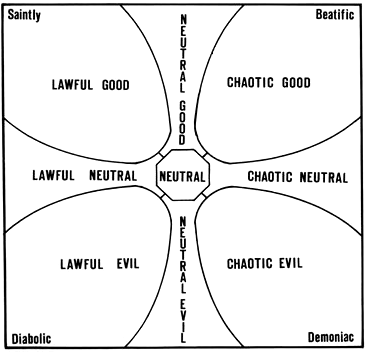
A character need not be intelligent or stupid to
be a specific alignment—and so an Evil character does not need to go around kicking
puppies and distressing damsels. That could lose valuable allies! An Evil
character simply thinks only of his
or herself. Evil is selfish. On the opposite side, a Good character can be an
idiot who accidentally harms people left and right—selflessness defines
goodness. Lex Luthor, like most stereotypical villains, puts himself first.
Where Robin Hood or the classic knight in shining armor regard people as ends,
as reasons to fight in themselves, Lex Luthor or the cackling villain see them
as means, stepping stones along the way.
Similarly, a Lawful character need not follow
the laws of the land—indeed, that Lawful Good knight would need to work against an unjust law. Anything else would go against
her convictions. A Lawful character believes in reacting to situations as an
example of the general: that a specific situation is best dealt with by
thinking of similar examples and what turned out to be a good or bad idea in
those situations. Similarly, a Chaotic character does not disobey laws randomly.
Chaotic characters believe each event should be judged unto itself. Though laws
matter less to a Chaotic individual, this fact is because law reflects a
mindset that a Chaotic individual disagrees with. The law of the land usually
lines up with what intelligent Lawful individuals would agree with, but the
fact that something is the law is orthogonal to whether a Chaotic or Lawful
character would do it. Neither Robin Hood nor a Chaotic Evil villain
particularly factor the law into their convictions, because they do not care.
Lex Luthor or a shining knight do care, the former for convenience and the
latter for the sake of doing what is right. Just as Evil characters will not
factor other’s well-being into their motivations, Chaotic characters need not
factor in the law.
Raskolnikov demonstrates all four of these
convictions in his two competing halves. One half—the half which kills
Litzaveta—is convinced rightness lies in Chaotic Evil, taking each situation
selfishly and as the only comparable example—the selfish superman. The other
half wrote the paper justifying the killing—explaining that an “extraordinary
man…[has] an inner right to decide” what right and wrong mean, and does so for
the common good—the egotistical superman (242). That half believes in being
Lawful Good. The heart of Raskolnikov’s split is that he believes he should be and is Lawful Good, yet the patterns he
seeks to follow are closer to Chaotic Evil. In the end, Raskolnikov is True
Neutral—he cares for his family, but not for people in general, and he takes
events as things unto themselves or as parts of a whole as suits him. He
remains True Neutral to the very end—finally coming to his senses for Sonia’s
sake, rather than his own or everyone’s, and understanding that the law has its
place.
Hamlet
of Oz
Hamlet, like Raskolnikov, is split down the
middle. Hamlet, however, evens out to Lawful Neutral. Hamlet finds the idea of
allowing his father’s murder to go unavenged unconscionable, and killing his
uncle and king without adequate proof similarly awful. Hamlet’s split
originates from his lack of relevant conviction—though he may have known who he
was at university, upon coming home, he is unsure of his rightness, his
birthright, and even his parentage.
The hardest times for Hamlet are when he
believes he is “alone.” During those times, Hamlet not only doubts his father’s
ghost, but believes firmly that he lacks the power to act. His first step
towards action, therefore, must be working around this conviction. Where
Raskolnikov performed the same action by shutting himself off from everyone,
Hamlet reaches out. Horatio helps Hamlet much, partially because any back-up helps,
partially because Horatio’s agreement about the ghost and Claudius’s guilty
appearance begin to convince Hamlet that he is right. Having a second opinion
lends him the motivation to move forward.
Having gained the necessary conviction, Hamlet
moves in pursuit of his goal—revenge—however he can. Despite disliking sneaky
tactics for being closer to his father’s murderer than his father, Hamlet uses
them: “the play’s the thing”, or sending Rosencrantz and Guildenstern to their
death by sending a false message with them. The prince’s conviction gives him
permission to use less savory tactics. As Glinda said to Dorothy, “You’ve
always had the power,” but Hamlet had to “learn it for himself.” As soon as
Hamlet gave himself permission to focus on one goal and use whatever tactic
presented itself to avenge his father, the task became easy.
It is a testament to the importance of
conviction that Shakespeare created a compelling play out of a character’s
shifting convictions, with only the last scene showing Hamlet accomplishing
anything pertaining to his vengeance.
Antigone
Antigone’s conviction takes her so far that she
no longer feels she has a choice. She is, depending on interpretation, Lawful
Neutral or Neutral Good—she believes that the gods’ law is the only important
one, and needs to be followed, come what punishment may. If she follows that
law out of moral belief that the gods’ law is just, then she is Neutral Good;
if she follows out of a belief that the gods’ law defines what is makes sense
to do, then she is Lawful Neutral. Antigone herself would not care in the
slightest. She believes that the gods’ law is more important than her
relationship with her ruler or her sister, and acts accordingly. Where Hamlet
and Raskolnikov convinced themselves that their actions were justifiable,
Antigone starts with the conviction to complete her goal, to satisfy the gods’
law.
Were Antigone’s goal to bury her brother, she
would be going about it poorly. Her ruler’s guards catch her, and she is
punished and prevented from properly burying her brother, almost before she can
even cover him with a proper layer of dust.
But simply burying her brother is not Antigone’s
goal. She believes in the gods’ law, and absolutely refuses to hide. When her
sister offers to keep her secret, Antigone reproves her: “Shout it from the
rooftops.” Where Hamlet was uncomfortable with sneaky practices because they
reminded him of his uncle, Antigone actively hates them, because she feels
certain she is doing nothing wrong. The only wrong, she feels, is in those who
would bow their heads to such injustice.
This being the case, Antigone’s actions all fall
into place. She will not make a fool of herself shouting against Creon, nor
will she remain silent at his injustice. When she steps forward to bury her
brother, the burial itself is incidental. She wants her brother to go through
the proper ceremonies, just as she wants Ismene to join in her fight, but
nothing will deter her from showing that Creon’s choice was wrong. She is so
certain of that fact that, even though she loses her family, she does not go uselessly
insane like Raskolnikov did. Her conviction is strong enough to push her
forward in her goal and keep her feet firmly planted on the ground, even with
every human in her world turning against her.
Where Raskolnikov had no one, and Hamlet had
Horatio by his side, Antigone stands firm by the gods, and so no mortal power
can dissuade her.
State of Wonder
Where Raskolnikov was True Neutral for being too
split to fall anywhere else, True Neutral Dr. Swenson simply does not fit
anywhere along the alignment spectrum of a normal person. She could have
loyalty to her funders, but treats them more like a nuisance. She could be
protective of those under her care, but, again, treats them as a nuisance,
except occasionally when they make good test subjects. She protects the Lakashi
tribe she studies, but that, again, seems more out of the annoyance that
visitors would bring to her lab than any real protective instinct for the
people. With her being so uncaring about what anyone else does, it would be
easy to peg her as Chaotic Evil—caring nothing for tradition, and for no one
except herself.
Yet Dr. Swenson does not even care for herself
in the traditional way. When an experiment is dangerous, she considers her body
just another available test subject. She tests a fertility drug on herself and
becomes pregnant at a post-menopausal age, when pregnancy in a perfectly
healthy woman could be dangerous in her environment. And, though she appears to
care for no one, she is focused on synthesizing a malaria vaccine, because she
knows it would save millions of lives. Dr. Swenson’s motivation does not fall
neatly onto Good or Evil, and her methods do not fall neatly into Lawful or
Chaotic. She is a thing unto herself. She refuses to be anything else.
Most importantly, Dr. Swenson is a thing certain
of itself. Though her motivations are (nearly) incomprehensible to those around
her, she will do everything in her power to make that malaria vaccine. The fact
that she is good at manipulating people helps, but the impetus for all this is
her being certain that she is doing what she should be doing. And, unlike
Hamlet or even Antigone, she needs no one, mortal or god, to tell her so.
Protector of the Small
Keladry, knight of the realm, is Lawful Good.
She is one of the most solidly Lawful Good characters I have ever interacted
with in any format. When her friends are in danger, she puts aside her own
fears, embarrassment, and well-being to protect those in her care—and ‘her
care’ includes just about everyone. When she goes on a trip while training to
be a knight and the group she is with is attacked, she takes the lead, not
because of any given authority, but because she can and she is best for the
job. No one ever asks Kel, and no one ever has to. Like Dr. Swenson, Kel
pursues her goals with the single-minded determination of someone who knows she
is right—though Keladry “Knight in Shining Armor” of Mindelan has a more
archetypal and understandable worldview.
By the end of the book series, everyone who
knows Kel knows she will do anything to protect those in her care. Those
fighting on the other side of a war against Kel’s Tortall do not know this, and
so are surprised when Kel goes against her king and commander’s orders to save
a group of children. Though her tactical skills help, she succeeds in saving
the children because she never hesitates: Had she waited for orders, she would
have been too late; had she doubted herself, she would have scared the children
into crying more loudly and the guards would have set off the alarm. Kel’s
conviction, like Antigone’s and Dr. Swenson’s, not only moves her to act, but
pushes her beyond the bounds of ordinary people. Kel could not do what she does
with only conviction, but her conviction lends her the ability to focus
entirely on what she does.
Dounia
and Sonia: Planted Firmly
Dounia begins the tale with conviction, enduring
insult and marrying or not marrying someone for her own reasons—and only for
her own reasons. From the first page, no one can dissuade her from her own
judgment. New information may change her mind, but Dounia is devoted to her
brother and her mother, and will not be moved by offers of money or her own
security from Luzhin, nor by possibilities even from Raskolnikov himself, until
she has rational reason to change her mind. Dounia is Lawful for her
rationality and practicality, and Neutral because she works for her family,
rather than on a grand, charitable scale. Dounia differs from Kel mainly in
scope. Dounia’s mother is also Lawful Neutral, but finds it difficult to make a
stand for herself, because her ideals, though identical to Dounia’s, are
beneath a layer of worry at going against the grain. Growing up in a house with
such a worrying mother likely gave Raskolnikov his split, for lack of a role
model, and Dounia her conviction, as she needed to hold up the family.
Sonia, similarly, stands firm in her beliefs to
protect her family. Her power is a touch subtler than Dounia’s, and much
subtler than anyone else’s I have listed in this paper. Sonia is sure of her
faith in God. This first manifests in a steadfast protection of her family by
keeping them fed: she has little choice, but she has the choice to leave them,
and does not. Her most important action in plot terms employs an oft-overlooked
power: forgiveness. Sonia believes no one is beyond saving, including
Raskolnikov, who killed her friend Lizaveta. Sonia’s belief in God and
forgiveness pushes Raskolnikov to confess.
Neither Dounia nor Sonia do anything as grand as
marching across enemy lines, or curing malaria, or killing someone wicked. But
what they do is find what they believe to be right, and stand by it, come what
may. Lawful Neutral Dounia will sacrifice herself for her family, and will not
give in to an evil person, and Lawful Good Sonia redeems Raskolnikov. No death,
no blood, yet each makes the world that much better.
Harry Potter and the Methods of Rationality
Chaotic Good Harry Potter in Harry Potter and the Methods of Rationality
often embodies how far guile and flexibility can get one. He takes each
situation, looks at every angle, and helps all the people he can, as much as he
can. Almost nothing can hold him back, and his classmates are under the
impression that he can do impossible things. For a given definition of
‘impossible,’ this is even true. Harry outright says, “If you think hard enough
you can do the impossible,” and believes every word with good reason—the
average person’s definition of ‘impossible’ does not apply to him. Harry knows
that he can move Heaven and Earth. All he has to do is find that one immovable
spot to stand and one particularly long lever.
One day, Harry finds his best friend Hermione in
danger of a fate worse than death, because she has been accused of a crime she
did not commit. Nothing in his life has been clearer: Hermione cannot save
herself, so Harry must find a way, some way, to save her, before the next day’s
trial. It would not matter how. His conviction reached the point where any and
every option is viable, be it new evidence, morally questionable scheming,
self-sacrifice, or all of the above.
And Harry learns, first-hand, a lesson he
already knew.
If you
think fast enough you can sometimes do the impossible quickly...
...sometimes.
Only sometimes.
Not
always.
Not reliably.
Strength
Conviction spurs people into action. Having
conviction as solid as bedrock can make the world appear as if the character
gained new strength, because unthinkable options become thinkable when the
alternative is worse. But conviction cannot make something from nothing.
Conviction is a push. If there is nothing to push, all the conviction in the
world will never come to more than a zephyr.
The Dungeons
and Dragons alignment system is made for powerful characters, whose
conviction will be readily apparent. No matter how strong or weak a character’s
conviction, sufficient power will illuminate it—the knight strikes down the
dastardly villain; Batman takes down pickpockets, muggers, and murderers.
Conviction spurs a character to action, and grants them the strength of doing
what another person might believe impossible, or unconscionable.
Though all the conviction in the world cannot
make up for a lack of strength or knowledge, it extends power, and power is
useless without it. If a character finds no reason
to do anything, then there is no point, and the character would not do
anything.
Works Cited
Advanced
Dungeons & Dragons, 2nd Edition, Player's Handbook. Lake
Geneva,
WI, USA: TSR, 1989. Print.
Dostoyevsky,
Fyodor. Crime and Punishment. New York: Modern Library, 1950.
Print.
Patchett,
Ann. State of Wonder. New York: Harper, 2011. Print.
Pierce,
Tamora. Protector of the Small. New York: Random
House, 2002. Print.
Pierce,
Tamora. The Will of the Empress. New York: Scholastic, 2005. Print.
Shakespeare,
William, André Gide, and Jacques Schiffrin. Hamlet. New York:
Pantheon, 1945. Print.
Sophocles,
and Richard Emil Braun. Antigone. New York: Oxford UP, 1973.
Print.
The
Wizard of Oz. Dir. Victor Fleming. Prod. Mervyn LeRoy. By
Noel Langley,
Florence Ryerson, Edgar Allan Woolf, Herbert
Stothart, Harold Arlen, E.
Y.
Harburg, and Harold Rosson. Perf. Judy Garland, Frank Morgan, Ray Bolger, Bert
Lahr, Jack Haley, Billie Burke, and Margaret Hamilton. Metro-Goldwyn-Mayer,
1939. DVD.
Yudkowsky,
Eliezer. "Harry Potter and the Methods of Rationality." Harry Potter
and the Methods of Rationality. Web. 04 May
2012.
Friday, May 11, 2012
Childish Sight
My name begins with an I. You need not know my name to hear this, and I choose not to give it. You may use whichever pronoun you choose for me, or just call me "I." Or nothing.
There were things I saw, when I was younger, that I didn't put into words. I didn't have the words for them. But then, we never do, at the time, do we?
In my mother's house, there is an old painted bell. The sound it made was my first definition of 'silver', though I might also use 'crystal'. It has that perfect, sparkling clarity. The handle is worn with use, and even now, when I hear someone talk of pealing, I think of that bell, that handle, and that crystal-silver ring.
The bell was my grandmother's, before she passed. My father's mother. Even after the divorce, my mother always got along better with her than her own mother. Grandma must have liked their visits, too, though I saw little of her before she died. Grandma left Mom the pealing bell in her will.
In my father's house, there is a piano. It was grandfather's--my father's father's. I don't know anything of my grandfather except that everyone agrees he played the piano beautifully, and I wasn't allowed to see him. If it weren't for a handful of hushed conversations, I might think he was dead.
My mother's parents are fine. They always have good things in their house. Sweets, candies, cookies, cakes. Shiny toys that I can take home, if I want. I don't know why, but they flinch, sometimes, when they see my mother. Like they failed with her. I don't know why that was yet, but I'm old enough to know I shouldn't ask.
There were things I saw, when I was younger, that I didn't put into words. I didn't have the words for them. But then, we never do, at the time, do we?
In my mother's house, there is an old painted bell. The sound it made was my first definition of 'silver', though I might also use 'crystal'. It has that perfect, sparkling clarity. The handle is worn with use, and even now, when I hear someone talk of pealing, I think of that bell, that handle, and that crystal-silver ring.
The bell was my grandmother's, before she passed. My father's mother. Even after the divorce, my mother always got along better with her than her own mother. Grandma must have liked their visits, too, though I saw little of her before she died. Grandma left Mom the pealing bell in her will.
In my father's house, there is a piano. It was grandfather's--my father's father's. I don't know anything of my grandfather except that everyone agrees he played the piano beautifully, and I wasn't allowed to see him. If it weren't for a handful of hushed conversations, I might think he was dead.
My mother's parents are fine. They always have good things in their house. Sweets, candies, cookies, cakes. Shiny toys that I can take home, if I want. I don't know why, but they flinch, sometimes, when they see my mother. Like they failed with her. I don't know why that was yet, but I'm old enough to know I shouldn't ask.
Friday, May 4, 2012
Words and History
I watch a show called Once upon a Time, and an episode (4/1/12, "The Stable Boy") had an interesting way of approaching a problem. An author character was talking to the sheriff, and suggested that she get past her block on an investigation the same way he gets past writer's block: Reread, now knowing how the story so far goes.
This is great for moving forward, I think, because we already know how we saw the story at that point in time. But, it works because it adds a perspective. There is something important about this perspective. There is also something important in how the author saw it the first time through.
History is a study in retrospect. We work like the author rereading a work to see where it was, in relation to the moment of where it is. The problem is, we don't always remember to think back on what is was when it was.
The first time I remember coming into contact with this was a biology class. We were learning Lamarckian evolution--which is wrong. My previous teachers had said, "This is what he thought; this is why it is absurd. Now, look at this Darwinian stuff!"
And then, one teacher said, "Now, this is wrong, but it's still important, because Lamarck came up with some theory for how it worked. He was trying to figure it out."
Which was a complete revelation to me, at the time. And I've thought about such things, since.
I've thought, Now we're in a world where, "Lamarckian evolution," "alchemy," and "magic" mean "fake," or "wrong," and where, "religion" means "unchanging."
It was not always so. It is not always so.
Lamarckian evolution and alchemy were attempts to understand the world. Attempts that came before us. They look no stranger to us than we will to those who follow us. Magic obviously exists--it describes anything people don't understand. And religion could change as things became more useful. It still does.
I have never heard anyone who was complaining about religion actually complain about religion. I have heard people complain about small-minded people, people who will not listen to reason, people who hate other people for what they are rather than who, people who cling too tightly to old ideas, but never about religion. I have heard some people say that all Christians are against gays, and that all gays are against Christianity, and I know that both ideas are absurd.
Were I placed in an English-speaking nation a few centuries ago, I would find the language difficult to incomprehensible, and they would find mine the same. The same language is entirely different a few centuries apart; individual words change even more quickly. Outdated concepts were not always outdated, and the words around them had not always shifted so.
This is great for moving forward, I think, because we already know how we saw the story at that point in time. But, it works because it adds a perspective. There is something important about this perspective. There is also something important in how the author saw it the first time through.
History is a study in retrospect. We work like the author rereading a work to see where it was, in relation to the moment of where it is. The problem is, we don't always remember to think back on what is was when it was.
The first time I remember coming into contact with this was a biology class. We were learning Lamarckian evolution--which is wrong. My previous teachers had said, "This is what he thought; this is why it is absurd. Now, look at this Darwinian stuff!"
And then, one teacher said, "Now, this is wrong, but it's still important, because Lamarck came up with some theory for how it worked. He was trying to figure it out."
Which was a complete revelation to me, at the time. And I've thought about such things, since.
I've thought, Now we're in a world where, "Lamarckian evolution," "alchemy," and "magic" mean "fake," or "wrong," and where, "religion" means "unchanging."
It was not always so. It is not always so.
Lamarckian evolution and alchemy were attempts to understand the world. Attempts that came before us. They look no stranger to us than we will to those who follow us. Magic obviously exists--it describes anything people don't understand. And religion could change as things became more useful. It still does.
I have never heard anyone who was complaining about religion actually complain about religion. I have heard people complain about small-minded people, people who will not listen to reason, people who hate other people for what they are rather than who, people who cling too tightly to old ideas, but never about religion. I have heard some people say that all Christians are against gays, and that all gays are against Christianity, and I know that both ideas are absurd.
Were I placed in an English-speaking nation a few centuries ago, I would find the language difficult to incomprehensible, and they would find mine the same. The same language is entirely different a few centuries apart; individual words change even more quickly. Outdated concepts were not always outdated, and the words around them had not always shifted so.
Friday, April 27, 2012
Welcome.
I come to speak of art, of the arts I know and love.
I come to speak of music. You have heard, I am sure, of the beauty of the song. Of the absolute spell-binding soulfulness, of comparisons to religion that may not fit, but do fit as well as anything in our language can. Of the flow, of the heart, of the wonder. Of everything we think of with, "art".
Those who speak of the work speak more quietly, or less frequently. Of long hours and difficult days. It may be for pride or humility, or simply for fear of scaring another artist from the land we know and love so well. And we do speak of the smooth, cornered, orderly side, of math and new languages, but we often speak only among ourselves, for too many have learned to fear math, or that they can't learn languages. For we know it doesn't matter if the beliefs are true, only if they believe.
I come to speak of math. You have heard, I am sure, of difficult equations. Of long hours and difficult days. It may be for pride or humility, or simply excusing one's own fear of the mathematical domain. We speak of the sharp, cornered, orderly side, of formulae and diagrams memorized.
It is difficult to speak up, for we have few role models who spoke the words. When someone, even an artist, a lover of music, says unapplied mathematics is useless, boring, it is difficult to speak back. I do not know a song to let play in my mind, to push me forward; I know no grand speeches.
Yes, math builds things. Music can inspire armies. But, at its heart, the beauty of math, the song and color and life, is intrinsic. One need not add anything to math to make it good, anymore than one need add to music.
Music has math in it, and math art.
I come to speak of music. You have heard, I am sure, of the beauty of the song. Of the absolute spell-binding soulfulness, of comparisons to religion that may not fit, but do fit as well as anything in our language can. Of the flow, of the heart, of the wonder. Of everything we think of with, "art".
Those who speak of the work speak more quietly, or less frequently. Of long hours and difficult days. It may be for pride or humility, or simply for fear of scaring another artist from the land we know and love so well. And we do speak of the smooth, cornered, orderly side, of math and new languages, but we often speak only among ourselves, for too many have learned to fear math, or that they can't learn languages. For we know it doesn't matter if the beliefs are true, only if they believe.
I come to speak of math. You have heard, I am sure, of difficult equations. Of long hours and difficult days. It may be for pride or humility, or simply excusing one's own fear of the mathematical domain. We speak of the sharp, cornered, orderly side, of formulae and diagrams memorized.
It is difficult to speak up, for we have few role models who spoke the words. When someone, even an artist, a lover of music, says unapplied mathematics is useless, boring, it is difficult to speak back. I do not know a song to let play in my mind, to push me forward; I know no grand speeches.
Yes, math builds things. Music can inspire armies. But, at its heart, the beauty of math, the song and color and life, is intrinsic. One need not add anything to math to make it good, anymore than one need add to music.
Music has math in it, and math art.
Friday, April 20, 2012
Rose and Briar
Rose's first thought had been, Me?
She was pretty; she knew it. Catalogued it, in fact. Nothing memorable--brown eyes, skin actually pretty similar to 'nude' clothing, mouse brown hair in a practical cut--but symmetrical. No scars from before her turning, and, of course, nothing she got afterward had stuck.
The vampire tried not to use this to her advantage too much, because an attractive woman could be memorable. Rose didn't mind being remembered for a few minutes, but she valued her freedom. Memory was fine, recognizing and calling her from across a room was not.
"Yes, you." Melia was her sire, and so had access to any unguarded thoughts. That first, Me? had been too sudden to guard, and her face would have given it away regardless. "He asked for someone no human would miss. You are the only one who fits."
"...And if I do not go?"
Melia held Rose's gaze. "Then," Melia said, as if the idea had only just occurred to her, "I will."
Rose took a breath. Avery liked her, but would move on quickly enough. Melia's Harmony would not. And, of course--Melia would never have asked Rose had there been a better candidate--only
Harmony was human.
"Why?" Why no humans?
From the outside, Melia gave Rose a neutral look.He had a bad experience with a human in the past, apparently. Torches and pitchforks sort of thing. He avoids them now, whenever he can.
Rose nodded. She knew the Beast. Had seen what he had done, and how little he understood. There was no bargaining; he would not understand he was hurting you. Like a dominance fight with a gorilla.
But he had never gone back on his word. He understood that. If he had promised to stay in the palace, and his one request was company...
It will only be dangerous for me, she thought, guarding, unsure how Melia would feel about that thought.
"When do I leave?"
She was pretty; she knew it. Catalogued it, in fact. Nothing memorable--brown eyes, skin actually pretty similar to 'nude' clothing, mouse brown hair in a practical cut--but symmetrical. No scars from before her turning, and, of course, nothing she got afterward had stuck.
The vampire tried not to use this to her advantage too much, because an attractive woman could be memorable. Rose didn't mind being remembered for a few minutes, but she valued her freedom. Memory was fine, recognizing and calling her from across a room was not.
"Yes, you." Melia was her sire, and so had access to any unguarded thoughts. That first, Me? had been too sudden to guard, and her face would have given it away regardless. "He asked for someone no human would miss. You are the only one who fits."
"...And if I do not go?"
Melia held Rose's gaze. "Then," Melia said, as if the idea had only just occurred to her, "I will."
Rose took a breath. Avery liked her, but would move on quickly enough. Melia's Harmony would not. And, of course--Melia would never have asked Rose had there been a better candidate--only
Harmony was human.
"Why?" Why no humans?
From the outside, Melia gave Rose a neutral look.He had a bad experience with a human in the past, apparently. Torches and pitchforks sort of thing. He avoids them now, whenever he can.
Rose nodded. She knew the Beast. Had seen what he had done, and how little he understood. There was no bargaining; he would not understand he was hurting you. Like a dominance fight with a gorilla.
But he had never gone back on his word. He understood that. If he had promised to stay in the palace, and his one request was company...
It will only be dangerous for me, she thought, guarding, unsure how Melia would feel about that thought.
"When do I leave?"
Friday, April 13, 2012
Quiver
There's a thrill to this, she thinks. And she knows that there's supposed to be. Each story she's heard of this sort of hunt speaks of something special. Seasoned hunters, warriors, soldiers, suddenly tensing up, getting oddly irritable, or just running. And the stories often speak of exactly the feeling she's getting: shivers down the spine, hair raised on the back of her neck, fidgeting because she wants to move. (It isn't the right thrill. The thrill isn't supposed to call her closer.)
Katherine blinks, then replays her thoughts. Hunter-warrior-soldier, tensing-irritable-running, shivers-nape-fidgets. Three groups of three. She'd heard of threes being important. But surely that wasn't so. It didn't happen like that--people told stories, but unicorns couldn't actually influence one's mind so finely, not by simple proximity.
A twig snapped. Her breath was speeding, and she should be afraid, but wasn't. What was it? This was a creature who had killed her kin, who had a horn more wicked than many swords, who defended the forest without a second thought--
Wait. What? She hadn't been thinking that last one.
The stories are true, then. Kate nocked an arrow, trying to find the thing. A twig had snapped, where had that been? Right. Near the rising sun. That was east, to her right. And there, right there, framed by the glow of a sun yet beneath the horizon, stood the unicorn.
He came toward her at a gentle trot.
She should be doing...something? (She lowered her bow. Katherine didn't want to shoot an ally, and there were no enemies near.)
A unicorn's horn, though wicked sharp, would heal things. Purge waters, wounds, sickness. That was all she thought of when he leaned closed to her, touched his horn to her forehead. (For surely, it was all he thought of.) The touch lifted an old pain, an old weight, one she had stopped recognizing when it became too consistent. (She dropped the bow and arrow, the beautiful bow. Remembering, that was always the part that baffled her the most. She could have put it away, it would have taken barely a moment.)
"Kate!" someone unimportant called. She heard a whistling sound, and then--
It lay dead at her feet. She blinked. The weight and pain were still gone, and the fearful beast was gone. It would make a splendid story for David to tell around the campfire, she supposed, him having saved her life, and her having been hypnotized by the unicorn.
He looked at her. Two dead eyes, in the wrong place for a horse's skull, looked at her. They had spoken for a moment. Communicated. Communed.
She wondered if Dave had needed to kill the unicorn. (She wondered if that was another trick of unicorn hypnotism, or her own thoughts. She wondered if she would ever be able to not-wonder that again.)
She shook her head to (loosen her mane) clear her head. The unicorn had taken blood of her tribe, and her tribe had taken blood of his to stop it. There was no shame in that.
"The beast is dead!"
Katherine blinks, then replays her thoughts. Hunter-warrior-soldier, tensing-irritable-running, shivers-nape-fidgets. Three groups of three. She'd heard of threes being important. But surely that wasn't so. It didn't happen like that--people told stories, but unicorns couldn't actually influence one's mind so finely, not by simple proximity.
A twig snapped. Her breath was speeding, and she should be afraid, but wasn't. What was it? This was a creature who had killed her kin, who had a horn more wicked than many swords, who defended the forest without a second thought--
Wait. What? She hadn't been thinking that last one.
The stories are true, then. Kate nocked an arrow, trying to find the thing. A twig had snapped, where had that been? Right. Near the rising sun. That was east, to her right. And there, right there, framed by the glow of a sun yet beneath the horizon, stood the unicorn.
He came toward her at a gentle trot.
She should be doing...something? (She lowered her bow. Katherine didn't want to shoot an ally, and there were no enemies near.)
A unicorn's horn, though wicked sharp, would heal things. Purge waters, wounds, sickness. That was all she thought of when he leaned closed to her, touched his horn to her forehead. (For surely, it was all he thought of.) The touch lifted an old pain, an old weight, one she had stopped recognizing when it became too consistent. (She dropped the bow and arrow, the beautiful bow. Remembering, that was always the part that baffled her the most. She could have put it away, it would have taken barely a moment.)
"Kate!" someone unimportant called. She heard a whistling sound, and then--
It lay dead at her feet. She blinked. The weight and pain were still gone, and the fearful beast was gone. It would make a splendid story for David to tell around the campfire, she supposed, him having saved her life, and her having been hypnotized by the unicorn.
He looked at her. Two dead eyes, in the wrong place for a horse's skull, looked at her. They had spoken for a moment. Communicated. Communed.
She wondered if Dave had needed to kill the unicorn. (She wondered if that was another trick of unicorn hypnotism, or her own thoughts. She wondered if she would ever be able to not-wonder that again.)
She shook her head to (loosen her mane) clear her head. The unicorn had taken blood of her tribe, and her tribe had taken blood of his to stop it. There was no shame in that.
"The beast is dead!"
Friday, April 6, 2012
Clean, Or: The Half-hidden Muse
There's a phrase-pattern I've heard from a few artists that interests me. It's...the worship of the untouched piece, I suppose. The chunk of marble for a sculptor, or the blank page for a writer, or a blank canvas for a painter. The first few times I heard it, it seemed like grandstanding. 'Anyone could do this, I just do it.'
But, having written with the idea in mind...I think I get it. I've gotten the advice, 'Start writing, then don't stop,' from a variety of reputable sources, and sometimes I even follow it. Often, this leaves me with a disorganized bundle of things that I can then sort out into a functioning piece because I've at least gotten them down.* The editing comes in, and then I understand my thoughts, so I can rewrite most of it and re-arrange what's salvageable.
And then I get these oddball things. Like, I was writing a paper in English class. It was on power, and I wrote a blog post on it before I even really knew how I was going to write the paper. The problem was, even after I figured out the basics of what I wanted to do, I didn't really have a starting point. I knew I wanted to make the point that power and choice were essentially synonymous, and I had some examples from Hamlet to back that up, but none were really worth starting the essay on.
Finally, I sat down. Step one: 'Start writing.'
Midas would work well here, said the blank computer screen. And I went, Oh, of course. Midas's turning-everything-to-gold thing seems like a blessing of power, and then he turns his daughter to gold and we realize that it's a weakness too, because he has no control over it.
Blank spaces are magic. Clear water, clear skies, random patterns in the clouds, bits of grain in the wood or lines in the stone. Something that is beautiful and inspires something by saying only, A thing could be here is magic, if anything ever was.
But, having written with the idea in mind...I think I get it. I've gotten the advice, 'Start writing, then don't stop,' from a variety of reputable sources, and sometimes I even follow it. Often, this leaves me with a disorganized bundle of things that I can then sort out into a functioning piece because I've at least gotten them down.* The editing comes in, and then I understand my thoughts, so I can rewrite most of it and re-arrange what's salvageable.
And then I get these oddball things. Like, I was writing a paper in English class. It was on power, and I wrote a blog post on it before I even really knew how I was going to write the paper. The problem was, even after I figured out the basics of what I wanted to do, I didn't really have a starting point. I knew I wanted to make the point that power and choice were essentially synonymous, and I had some examples from Hamlet to back that up, but none were really worth starting the essay on.
Finally, I sat down. Step one: 'Start writing.'
Midas would work well here, said the blank computer screen. And I went, Oh, of course. Midas's turning-everything-to-gold thing seems like a blessing of power, and then he turns his daughter to gold and we realize that it's a weakness too, because he has no control over it.
Blank spaces are magic. Clear water, clear skies, random patterns in the clouds, bits of grain in the wood or lines in the stone. Something that is beautiful and inspires something by saying only, A thing could be here is magic, if anything ever was.
* I can also get it falling more or less into place, but if it falls that neatly, I probably didn't need someone to tell me to write.
Friday, March 30, 2012
Half
If I may speak--sorry? No, I'd rather stand, if that's alright. I've been sitting all day. Thank you.
If I may speak? Thank you. I don't really understand why you needed to see me for this. Yes. Yes, of course. It's your decision. I understand. You don't have to explain yourself, I was just registering my lack of understanding on the record.
Right.
So.
I don't particularly think it matters. I mean, any of it. I understand that it matters to some people, including intelligent people. I just don't know why it matters. Like, if you show me a spectrum, and say, "Here's the red; here's the orange," I understand that a lot of people would agree with you on that. I probably would, though I'd draw the line a little differently. But that doesn't explain why we drew the lines there. The what and the why are different things.
That's kind of why I didn't want to be seen. I mean, I came, of course; you can see that. But, if I could choose my medium, I'd rather it be only my words. My tone and body language, too, if I could do that without signaling other things about me, but just my words would work well.
Yes. That's why. Everyone's a little prejudiced about something, so I'd rather be unseen, so each person can make as few assumptions as possible. Yes. I know. They'll probably assign me a gender and things like that. But it's a bit better--like the way that Dr. Thomson probably pops into your head as male if you expect doctors to be male. It's the default, so that means I get your default settings.
Okay--okay, yes, I'll start.
It's an issue of sexism.
No. No, it's not an issue of sexual orientation. I mean, maybe it started out that way, maybe that's a root or even the root, but in practice, it's sexist. It's like that law where more African-Americans were being executed than any other group. The idea behind the death penalty wasn't racist, but it was applied in a racist fashion.
It's true, that a heterosexual person can marry the sort of partner he or she is likely to choose, and a homosexual person cannot. But both of them are granted, for instance, the right to a loveless marriage, and their pools are equally limited.
Anyway. That's not even the argument I hear the other side use. It's about making a cohesive family unit. Or something of that ilk. I don't understand that at all--we get abusive relationships between partners of the opposite sex, and I have to imagine that's worse on the theoretical child. And there are people who can't conceive. But that's not where I'm going.
What about people who are bisexual? You're not stopping me from marrying someone I like; you're stopping me from marrying half my pool of possible mates. It's exactly like outlawing interracial marriage; it's racist because you're telling me who I can and can't marry based on race. Therefore, telling me who I can and can't marry based on sex is sexist. You are taking my race and my partner's sex into account, but you were also taking both our races into account. It's the same thing.
Oh, wait. I wanted to keep anything about me out of this. Can we strike me saying I'm bi? No, I'd say the same stuff; I'd just leave it vague that I am-- Oh. No, I understand. Can we strike this, then? Thank you.
Yes. Yes, I know. Rome was not built in a day. We know the words. Hm? Yes, I said, 'we'. Why? Because we all do. Everyone who's been through any human rights movement does. "Wait," means, "Never," and both sides tend to make in-groups. That's actually an interesting one, from our perspective, since I refuse to pass for gay or straight, so I end up being accused of trying to pass for both--because mixed-race children always had it easier, right? I mean, where I grew up, it was pretty much social suicide to say that someone who'd come out as homosexual was straight and "just confused," but saying the same thing to a person who'd come out as bisexual was fine. Asexual, too.
Hm? Oh, no, that time was intentional. If they're going to know anyway, I might as well make use of it. Uh...I don't see why you'd want to, but I didn't say anything important here. Sure.
I guess my main point is that it's just a human right. You can find a lot of cultures that accept it, and it pops up a fair bit in the animal kingdom, so it's odd to call it unnatural. Really, monogamy is more unnatural than homosexuality. However you look at it. Promiscuity and polyamory are more common than monogamy. No, I'm not condemning it. No, not condemning that either. Wait-- No, just--
Wait.
...
Thank you. I'm not condemning anything. That's not why I'm here, and I wouldn't be here if that were my purpose. I'd just like to be able to raise any children I might have while secure in the knowledge that the law is on their side, if they want to do things that other people have the right to do.
Thank you for your time. I'll show myself out.
If I may speak? Thank you. I don't really understand why you needed to see me for this. Yes. Yes, of course. It's your decision. I understand. You don't have to explain yourself, I was just registering my lack of understanding on the record.
Right.
So.
I don't particularly think it matters. I mean, any of it. I understand that it matters to some people, including intelligent people. I just don't know why it matters. Like, if you show me a spectrum, and say, "Here's the red; here's the orange," I understand that a lot of people would agree with you on that. I probably would, though I'd draw the line a little differently. But that doesn't explain why we drew the lines there. The what and the why are different things.
That's kind of why I didn't want to be seen. I mean, I came, of course; you can see that. But, if I could choose my medium, I'd rather it be only my words. My tone and body language, too, if I could do that without signaling other things about me, but just my words would work well.
Yes. That's why. Everyone's a little prejudiced about something, so I'd rather be unseen, so each person can make as few assumptions as possible. Yes. I know. They'll probably assign me a gender and things like that. But it's a bit better--like the way that Dr. Thomson probably pops into your head as male if you expect doctors to be male. It's the default, so that means I get your default settings.
Okay--okay, yes, I'll start.
It's an issue of sexism.
No. No, it's not an issue of sexual orientation. I mean, maybe it started out that way, maybe that's a root or even the root, but in practice, it's sexist. It's like that law where more African-Americans were being executed than any other group. The idea behind the death penalty wasn't racist, but it was applied in a racist fashion.
It's true, that a heterosexual person can marry the sort of partner he or she is likely to choose, and a homosexual person cannot. But both of them are granted, for instance, the right to a loveless marriage, and their pools are equally limited.
Anyway. That's not even the argument I hear the other side use. It's about making a cohesive family unit. Or something of that ilk. I don't understand that at all--we get abusive relationships between partners of the opposite sex, and I have to imagine that's worse on the theoretical child. And there are people who can't conceive. But that's not where I'm going.
What about people who are bisexual? You're not stopping me from marrying someone I like; you're stopping me from marrying half my pool of possible mates. It's exactly like outlawing interracial marriage; it's racist because you're telling me who I can and can't marry based on race. Therefore, telling me who I can and can't marry based on sex is sexist. You are taking my race and my partner's sex into account, but you were also taking both our races into account. It's the same thing.
Yes. Yes, I know. Rome was not built in a day. We know the words. Hm? Yes, I said, 'we'. Why? Because we all do. Everyone who's been through any human rights movement does. "Wait," means, "Never," and both sides tend to make in-groups. That's actually an interesting one, from our perspective, since I refuse to pass for gay or straight, so I end up being accused of trying to pass for both--because mixed-race children always had it easier, right? I mean, where I grew up, it was pretty much social suicide to say that someone who'd come out as homosexual was straight and "just confused," but saying the same thing to a person who'd come out as bisexual was fine. Asexual, too.
I guess my main point is that it's just a human right. You can find a lot of cultures that accept it, and it pops up a fair bit in the animal kingdom, so it's odd to call it unnatural. Really, monogamy is more unnatural than homosexuality. However you look at it. Promiscuity and polyamory are more common than monogamy. No, I'm not condemning it. No, not condemning that either. Wait-- No, just--
Wait.
...
Thank you. I'm not condemning anything. That's not why I'm here, and I wouldn't be here if that were my purpose. I'd just like to be able to raise any children I might have while secure in the knowledge that the law is on their side, if they want to do things that other people have the right to do.
Thank you for your time. I'll show myself out.
Friday, March 23, 2012
Blade and Fang
The part of a recent-ish English paper that I liked. Except the pictures, because I don't know how to make blogger actually re-size. (As opposed to saying it re-sized the image.)Lies. The word hisses like a venomous serpent. We are told from a very young age that honesty is the best policy, that we should not emulate the boy who cried, “Wolf!”
Then, as we grow, we are taught of ‘white lies’. These are lies that we may tell. White lies protect lives, secrets, and happiness. The white lie to keep a secret is a tame snake: the little one is your pet, but it is yet reptilian, and close enough kin to the hissing striker of a black lie to make many uncomfortable. Still, we feed these snakes; we let them in our homes. They are not dogs, to sleep at the foot of our beds, but we live happily enough with them. Some may even enjoy the company—a lie told gives closure in a way that, “I can’t tell you,” does not. Yet still. It is odd to allow them too close. Strange to like them too much.
Last, we have the shining white lie. This is no serpent-kin, but a knight in shining armor, forever at the ready to protect others from horrors which might be too much for the poor things’ constitution.
When lies are wrong, they are a failure: A black lie is a failure of conscience. A white lie is a failure of creativity. A shining white lie is a failure of empathy. As Elizabeth tells Will in Pirates of the Caribbean, and Will spits back at her, “It wasn't your burden to bear”—each decided the other would rather not know a secret, and each was wrong. The speaker pities the listener enough to withhold information. Or, sometimes, it is a failure of courage: the inability of the speaker to face the truth, and so the inability to speak it. Or the inability to admit to a secret by saying, “I can’t tell you,” or, “It is not my secret to tell.”
All lies have two elements: the living half and the tool half. The living half has a mind of its own—a serpent-lie may come back to bite the liar; a knight-lie may slice into someone the liar did not intend. The living half comes into being once the lie is told, and then cannot be taken away completely, not even by telling to truth. Truth means little without trust. The tool half, on the other hand, remains whether or not the lie is told. The sword rests sheathed on the knight’s belt; the serpent’s venom rests in a vial. The important thing to remember is that lies need not destroy. Next to the sword rests the shield—a shining white lie is assuming another’s weakness; the liar need not be wrong. And, though we are right to be wary of snake’s venom, the venom is its own antidote. The trick is that we need someone with a clear head to wield both sword and shield, and to measure out the venom. Lacking that, a liar may slice off a limb without meaning to, or poison someone who needed no antidote. The liar needs to understand the situation.
Put it simply: Liars should not lie to themselves. A liar who breaks this rule is trying to self-apply an antidote while delirious with fever. One who tells a shining lie without facing the truth strikes at a dragon while blind and deaf.
Wednesday, March 21, 2012
World Poetry Day
Today is. And I haven't written a poem in too long. This is...free-form, I suppose?
Once upon a Time
I love the old stories
When I was young, glories
Beautiful little things of light.
I'm older, know older ends
The wolf at the door doesn't always die
It's not always alright.
(I knew dragons, but not in my tales
(Didn't know how to speak without veils.)
Red died, sometimes.
Before then, she was clever.
(The trick with the rope around the tree.)
Rapunzel's witch was strong
She wandered with twins
(Her he saved, then him she.)
Beauty wasn't always smart
But she was always a hero
(Sacrifice, endurance to earn her glee.)
The old stories are always important, I think.
The dark can win--yet we try, still.
And, important to me, if a subtler hill:
Stories of women's strength are older than a blink.
Once upon a Time
I love the old stories
When I was young, glories
Beautiful little things of light.
I'm older, know older ends
The wolf at the door doesn't always die
It's not always alright.
(I knew dragons, but not in my tales
(Didn't know how to speak without veils.)
Red died, sometimes.
Before then, she was clever.
(The trick with the rope around the tree.)
Rapunzel's witch was strong
She wandered with twins
(Her he saved, then him she.)
Beauty wasn't always smart
But she was always a hero
(Sacrifice, endurance to earn her glee.)
The old stories are always important, I think.
The dark can win--yet we try, still.
And, important to me, if a subtler hill:
Stories of women's strength are older than a blink.
Friday, March 16, 2012
Senioritis
Rapunzel was in a tower for most of her life. Her first step out into the world was, interestingly enough, the outside world coming in--the prince. The second was the desert. She had the good and the bad, and, since it's a fairy tale, it worked out in the end.
Now, you're Rapunzel. Specifically, a Rapunzel who has been warned of the outside world, and also told some of the amazing things. The witch held up leaving the tower as one of the most important moments in your life, and explained that it will happen on this very specific date. That you have a tower filled with books, movies, songs all based around the various lands outside your tower. And it is very important that you keep up on your studies, because if you fall enough behind, you'll get stuck in the tower, and never learn of the land outside.
Enter: Prince.
The prince smiles. He points out the time that can elapse between now and your leaving the tower. Then, he shows you exactly how little work you have to do to leave the tower, between now and then. All these things you've been doing just to leave the tower now barely matter. Because the date is set. Unless you actually try to get stuck here, he explains, you'll leave.
Your first feeling is probably simple glee. You've been working your whole life to reach this goal! There are so many wonderful, unbelievable things outside your tower!
And you're safe. For the first time in your life in nearly two decades, you don't have to bother. You get to leave on a schedule; you know when it's coming. And you're probably a touch restless. That may make you want to try new things: sneak out of the tower, or not study for tests, or stay up all night doing something frivolous. And there would be few or no negative consequences for doing so.
Then it strikes you, quite suddenly, that you may never have this opportunity again.
In that moment, the witch's warnings mean very little. That novel you wanted to pick up, the movie you wanted to stay up all night watching, the prince's touch, mean much.
You are free. You are old enough to be left alone to do things, and can shuck responsibilities without hurting people. You have been in the tower long enough to know this combination has not happened before, and know little enough of the world outside to not know if it will ever happen again.
Your future is set and planned for. Your past is done.
The prince's hand fits well in yours, and you live your next few months of moments in the present.
Now, you're Rapunzel. Specifically, a Rapunzel who has been warned of the outside world, and also told some of the amazing things. The witch held up leaving the tower as one of the most important moments in your life, and explained that it will happen on this very specific date. That you have a tower filled with books, movies, songs all based around the various lands outside your tower. And it is very important that you keep up on your studies, because if you fall enough behind, you'll get stuck in the tower, and never learn of the land outside.
Enter: Prince.
The prince smiles. He points out the time that can elapse between now and your leaving the tower. Then, he shows you exactly how little work you have to do to leave the tower, between now and then. All these things you've been doing just to leave the tower now barely matter. Because the date is set. Unless you actually try to get stuck here, he explains, you'll leave.
Your first feeling is probably simple glee. You've been working your whole life to reach this goal! There are so many wonderful, unbelievable things outside your tower!
And you're safe. For the first time in your life in nearly two decades, you don't have to bother. You get to leave on a schedule; you know when it's coming. And you're probably a touch restless. That may make you want to try new things: sneak out of the tower, or not study for tests, or stay up all night doing something frivolous. And there would be few or no negative consequences for doing so.
Then it strikes you, quite suddenly, that you may never have this opportunity again.
In that moment, the witch's warnings mean very little. That novel you wanted to pick up, the movie you wanted to stay up all night watching, the prince's touch, mean much.
You are free. You are old enough to be left alone to do things, and can shuck responsibilities without hurting people. You have been in the tower long enough to know this combination has not happened before, and know little enough of the world outside to not know if it will ever happen again.
Your future is set and planned for. Your past is done.
The prince's hand fits well in yours, and you live your next few months of moments in the present.
Friday, March 9, 2012
Let Light In

The mystery adds to this piece's artistry. But not all work needs to be mysterious--there are other things even in this work. The careful brush strokes to make realistic hair, or the ragged edges and gradually layering of the fog itself.
The mysteriousness adds to this work, but a work need not be mysterious to be good. Yet critics often say the same thing of works that are comedic: They cannot be 'true' art--whatever that means.
Even our language reflects this reaction: is serious literature good literature, or literature that is not comedic? Comedy cannot be serious literature; it hardly matters. Franz Kafka put this idea as bluntly as one can: "I think we ought to read only the kind of books that wound and stab us. If the book we are reading doesn't wake us up with a blow on the head, what are we reading it for?"
Comedies can teach us about life. If every piece of wisdom we gained left us a shattered wreck, all geniuses would be sociopaths in self-defense. There's a limit to how many times one can shatter before losing pieces. And an entirely angsty work has the same issue a saccharine one does: the audience stops caring.

Anyone who says rain washes away sin has never laughed in the sunlight.
Friday, March 2, 2012
Birthright
You are born to the Earth. Whether you believe it to be merely a test for the next world or wholly valuable in itself, you are born.
And it is no mean thing to be born. In your line are nobles, kings--for the blood mingles each generation, the blood spreads. In your line philosophers. In your line warriors. In your line heroes(; in your line villains). Always, always strength.
For you, little green-white-red-black growing thing, are born of survivors. Little sun-yellow one, you are born of those who saw the serpent, who fought the dragon, who ran swift', spoke well, lived.
A boy in one of our legends--for we still make legends, even should few think to call them that--is, simply, "The Boy Who Lived". He fights, and he wins, by power of love and bravery. What do you think you are, dear star-bright? What do you think your ancestors fought for?
We are pack and tribe. We are young and old, dark and bright, good and awful. We are we. When the world shakes, and there's nothing left to hold, a hand is there.
You are born of fight and fire and loss and love. You live, little dear one mine. Never forget.
And it is no mean thing to be born. In your line are nobles, kings--for the blood mingles each generation, the blood spreads. In your line philosophers. In your line warriors. In your line heroes(; in your line villains). Always, always strength.
For you, little green-white-red-black growing thing, are born of survivors. Little sun-yellow one, you are born of those who saw the serpent, who fought the dragon, who ran swift', spoke well, lived.
A boy in one of our legends--for we still make legends, even should few think to call them that--is, simply, "The Boy Who Lived". He fights, and he wins, by power of love and bravery. What do you think you are, dear star-bright? What do you think your ancestors fought for?
We are pack and tribe. We are young and old, dark and bright, good and awful. We are we. When the world shakes, and there's nothing left to hold, a hand is there.
You are born of fight and fire and loss and love. You live, little dear one mine. Never forget.
Subscribe to:
Posts (Atom)