Showing posts with label school assignment. Show all posts

Friday, May 18, 2012

Conviction

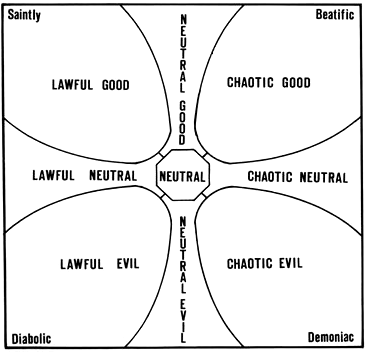
Convictions form the heart of anyone's power. Though conviction alone is not enough to accomplish one's goals, nothing matters without conviction. All the ability in the world will come to nothing if the person with the power has no impetus to use it. Therefore, when discussing power, one must discuss conviction. My favorite language for doing so comes from Dungeons and Dragons: The game separates the characters well, while still leaving them leeway enough to be as dynamic, static, round or flat as the character demands.
Alignment
In Dungeons and Dragons, there are nine alignments: Lawful, Neutral, and Chaotic pair off with Good, Neutral, and Evil. These define the basics of a character’s morality, and most characters fit the alignment one would expect: a knight in shining armor would be Lawful Good; Robin Hood would be Chaotic Good; most flat villains would be Chaotic Evil; Lex Luthor would be Lawful Evil. The interesting part comes from working out what each alignment means. What makes a character an alignment is the character’s motivation—so what motivates Robin Hood that sets him apart from a knight? What makes Lex Luthor different from the sort of villain who twirls his mustache?
A character need not be intelligent or stupid to be a specific alignment—and so an Evil character does not need to go around kicking puppies and distressing damsels. That could lose valuable allies! An Evil character simply thinks only of his or herself. Evil is selfish. On the opposite side, a Good character can be an idiot who accidentally harms people left and right—selflessness defines goodness. Lex Luthor, like most stereotypical villains, puts himself first. Where Robin Hood or the classic knight in shining armor regard people as ends, as reasons to fight in themselves, Lex Luthor or the cackling villain see them as means, stepping stones along the way.
Similarly, a Lawful character need not follow the laws of the land—indeed, that Lawful Good knight would need to work against an unjust law. Anything else would go against her convictions. A Lawful character believes in reacting to situations as an example of the general: that a specific situation is best dealt with by thinking of similar examples and what turned out to be a good or bad idea in those situations. Similarly, a Chaotic character does not disobey laws randomly. Chaotic characters believe each event should be judged unto itself. Though laws matter less to a Chaotic individual, this fact is because law reflects a mindset that a Chaotic individual disagrees with. The law of the land usually lines up with what intelligent Lawful individuals would agree with, but the fact that something is the law is orthogonal to whether a Chaotic or Lawful character would do it. Neither Robin Hood nor a Chaotic Evil villain particularly factor the law into their convictions, because they do not care. Lex Luthor or a shining knight do care, the former for convenience and the latter for the sake of doing what is right. Just as Evil characters will not factor other’s well-being into their motivations, Chaotic characters need not factor in the law.
Raskolnikov demonstrates all four of these convictions in his two competing halves. One half—the half which kills Litzaveta—is convinced rightness lies in Chaotic Evil, taking each situation selfishly and as the only comparable example—the selfish superman. The other half wrote the paper justifying the killing—explaining that an “extraordinary man…[has] an inner right to decide” what right and wrong mean, and does so for the common good—the egotistical superman (242). That half believes in being Lawful Good. The heart of Raskolnikov’s split is that he believes he should be and is Lawful Good, yet the patterns he seeks to follow are closer to Chaotic Evil. In the end, Raskolnikov is True Neutral—he cares for his family, but not for people in general, and he takes events as things unto themselves or as parts of a whole as suits him. He remains True Neutral to the very end—finally coming to his senses for Sonia’s sake, rather than his own or everyone’s, and understanding that the law has its place.
Hamlet of Oz
Hamlet, like Raskolnikov, is split down the middle. Hamlet, however, evens out to Lawful Neutral. Hamlet finds the idea of allowing his father’s murder to go unavenged unconscionable, and killing his uncle and king without adequate proof similarly awful. Hamlet’s split originates from his lack of relevant conviction—though he may have known who he was at university, upon coming home, he is unsure of his rightness, his birthright, and even his parentage.
The hardest times for Hamlet are when he believes he is “alone.” During those times, Hamlet not only doubts his father’s ghost, but believes firmly that he lacks the power to act. His first step towards action, therefore, must be working around this conviction. Where Raskolnikov performed the same action by shutting himself off from everyone, Hamlet reaches out. Horatio helps Hamlet much, partially because any back-up helps, partially because Horatio’s agreement about the ghost and Claudius’s guilty appearance begin to convince Hamlet that he is right. Having a second opinion lends him the motivation to move forward.
Having gained the necessary conviction, Hamlet moves in pursuit of his goal—revenge—however he can. Despite disliking sneaky tactics for being closer to his father’s murderer than his father, Hamlet uses them: “the play’s the thing”, or sending Rosencrantz and Guildenstern to their death by sending a false message with them. The prince’s conviction gives him permission to use less savory tactics. As Glinda said to Dorothy, “You’ve always had the power,” but Hamlet had to “learn it for himself.” As soon as Hamlet gave himself permission to focus on one goal and use whatever tactic presented itself to avenge his father, the task became easy.
It is a testament to the importance of conviction that Shakespeare created a compelling play out of a character’s shifting convictions, with only the last scene showing Hamlet accomplishing anything pertaining to his vengeance.
Antigone
Antigone’s conviction takes her so far that she no longer feels she has a choice. She is, depending on interpretation, Lawful Neutral or Neutral Good—she believes that the gods’ law is the only important one, and needs to be followed, come what punishment may. If she follows that law out of moral belief that the gods’ law is just, then she is Neutral Good; if she follows out of a belief that the gods’ law defines what is makes sense to do, then she is Lawful Neutral. Antigone herself would not care in the slightest. She believes that the gods’ law is more important than her relationship with her ruler or her sister, and acts accordingly. Where Hamlet and Raskolnikov convinced themselves that their actions were justifiable, Antigone starts with the conviction to complete her goal, to satisfy the gods’ law.
Were Antigone’s goal to bury her brother, she would be going about it poorly. Her ruler’s guards catch her, and she is punished and prevented from properly burying her brother, almost before she can even cover him with a proper layer of dust.
But simply burying her brother is not Antigone’s goal. She believes in the gods’ law, and absolutely refuses to hide. When her sister offers to keep her secret, Antigone reproves her: “Shout it from the rooftops.” Where Hamlet was uncomfortable with sneaky practices because they reminded him of his uncle, Antigone actively hates them, because she feels certain she is doing nothing wrong. The only wrong, she feels, is in those who would bow their heads to such injustice.
This being the case, Antigone’s actions all fall into place. She will not make a fool of herself shouting against Creon, nor will she remain silent at his injustice. When she steps forward to bury her brother, the burial itself is incidental. She wants her brother to go through the proper ceremonies, just as she wants Ismene to join in her fight, but nothing will deter her from showing that Creon’s choice was wrong. She is so certain of that fact that, even though she loses her family, she does not go uselessly insane like Raskolnikov did. Her conviction is strong enough to push her forward in her goal and keep her feet firmly planted on the ground, even with every human in her world turning against her.
Where Raskolnikov had no one, and Hamlet had Horatio by his side, Antigone stands firm by the gods, and so no mortal power can dissuade her.
State of Wonder
Where Raskolnikov was True Neutral for being too split to fall anywhere else, True Neutral Dr. Swenson simply does not fit anywhere along the alignment spectrum of a normal person. She could have loyalty to her funders, but treats them more like a nuisance. She could be protective of those under her care, but, again, treats them as a nuisance, except occasionally when they make good test subjects. She protects the Lakashi tribe she studies, but that, again, seems more out of the annoyance that visitors would bring to her lab than any real protective instinct for the people. With her being so uncaring about what anyone else does, it would be easy to peg her as Chaotic Evil—caring nothing for tradition, and for no one except herself.
Yet Dr. Swenson does not even care for herself in the traditional way. When an experiment is dangerous, she considers her body just another available test subject. She tests a fertility drug on herself and becomes pregnant at a post-menopausal age, when pregnancy in a perfectly healthy woman could be dangerous in her environment. And, though she appears to care for no one, she is focused on synthesizing a malaria vaccine, because she knows it would save millions of lives. Dr. Swenson’s motivation does not fall neatly onto Good or Evil, and her methods do not fall neatly into Lawful or Chaotic. She is a thing unto herself. She refuses to be anything else.
Most importantly, Dr. Swenson is a thing certain of itself. Though her motivations are (nearly) incomprehensible to those around her, she will do everything in her power to make that malaria vaccine. The fact that she is good at manipulating people helps, but the impetus for all this is her being certain that she is doing what she should be doing. And, unlike Hamlet or even Antigone, she needs no one, mortal or god, to tell her so.
Protector of the Small
Keladry, knight of the realm, is Lawful Good. She is one of the most solidly Lawful Good characters I have ever interacted with in any format. When her friends are in danger, she puts aside her own fears, embarrassment, and well-being to protect those in her care—and ‘her care’ includes just about everyone. When she goes on a trip while training to be a knight and the group she is with is attacked, she takes the lead, not because of any given authority, but because she can and she is best for the job. No one ever asks Kel, and no one ever has to. Like Dr. Swenson, Kel pursues her goals with the single-minded determination of someone who knows she is right—though Keladry “Knight in Shining Armor” of Mindelan has a more archetypal and understandable worldview.
By the end of the book series, everyone who knows Kel knows she will do anything to protect those in her care. Those fighting on the other side of a war against Kel’s Tortall do not know this, and so are surprised when Kel goes against her king and commander’s orders to save a group of children. Though her tactical skills help, she succeeds in saving the children because she never hesitates: Had she waited for orders, she would have been too late; had she doubted herself, she would have scared the children into crying more loudly and the guards would have set off the alarm. Kel’s conviction, like Antigone’s and Dr. Swenson’s, not only moves her to act, but pushes her beyond the bounds of ordinary people. Kel could not do what she does with only conviction, but her conviction lends her the ability to focus entirely on what she does.
Dounia and Sonia: Planted Firmly
Dounia begins the tale with conviction, enduring insult and marrying or not marrying someone for her own reasons—and only for her own reasons. From the first page, no one can dissuade her from her own judgment. New information may change her mind, but Dounia is devoted to her brother and her mother, and will not be moved by offers of money or her own security from Luzhin, nor by possibilities even from Raskolnikov himself, until she has rational reason to change her mind. Dounia is Lawful for her rationality and practicality, and Neutral because she works for her family, rather than on a grand, charitable scale. Dounia differs from Kel mainly in scope. Dounia’s mother is also Lawful Neutral, but finds it difficult to make a stand for herself, because her ideals, though identical to Dounia’s, are beneath a layer of worry at going against the grain. Growing up in a house with such a worrying mother likely gave Raskolnikov his split, for lack of a role model, and Dounia her conviction, as she needed to hold up the family.
Sonia, similarly, stands firm in her beliefs to protect her family. Her power is a touch subtler than Dounia’s, and much subtler than anyone else’s I have listed in this paper. Sonia is sure of her faith in God. This first manifests in a steadfast protection of her family by keeping them fed: she has little choice, but she has the choice to leave them, and does not. Her most important action in plot terms employs an oft-overlooked power: forgiveness. Sonia believes no one is beyond saving, including Raskolnikov, who killed her friend Lizaveta. Sonia’s belief in God and forgiveness pushes Raskolnikov to confess.
Neither Dounia nor Sonia do anything as grand as marching across enemy lines, or curing malaria, or killing someone wicked. But what they do is find what they believe to be right, and stand by it, come what may. Lawful Neutral Dounia will sacrifice herself for her family, and will not give in to an evil person, and Lawful Good Sonia redeems Raskolnikov. No death, no blood, yet each makes the world that much better.
Harry Potter and the Methods of Rationality
Chaotic Good Harry Potter in Harry Potter and the Methods of Rationality often embodies how far guile and flexibility can get one. He takes each situation, looks at every angle, and helps all the people he can, as much as he can. Almost nothing can hold him back, and his classmates are under the impression that he can do impossible things. For a given definition of ‘impossible,’ this is even true. Harry outright says, “If you think hard enough you can do the impossible,” and believes every word with good reason—the average person’s definition of ‘impossible’ does not apply to him. Harry knows that he can move Heaven and Earth. All he has to do is find that one immovable spot to stand and one particularly long lever.
One day, Harry finds his best friend Hermione in danger of a fate worse than death, because she has been accused of a crime she did not commit. Nothing in his life has been clearer: Hermione cannot save herself, so Harry must find a way, some way, to save her, before the next day’s trial. It would not matter how. His conviction reached the point where any and every option is viable, be it new evidence, morally questionable scheming, self-sacrifice, or all of the above.
And Harry learns, first-hand, a lesson he already knew.
If you think fast enough you can sometimes do the impossible quickly...
...sometimes.
Only sometimes.
Not always.
Not reliably.
Strength
Conviction spurs people into action. Having conviction as solid as bedrock can make the world appear as if the character gained new strength, because unthinkable options become thinkable when the alternative is worse. But conviction cannot make something from nothing. Conviction is a push. If there is nothing to push, all the conviction in the world will never come to more than a zephyr.
The Dungeons and Dragons alignment system is made for powerful characters, whose conviction will be readily apparent. No matter how strong or weak a character’s conviction, sufficient power will illuminate it—the knight strikes down the dastardly villain; Batman takes down pickpockets, muggers, and murderers. Conviction spurs a character to action, and grants them the strength of doing what another person might believe impossible, or unconscionable.
Though all the conviction in the world cannot make up for a lack of strength or knowledge, it extends power, and power is useless without it. If a character finds no reason to do anything, then there is no point, and the character would not do anything.

Works Cited
Advanced Dungeons & Dragons, 2nd Edition, Player's Handbook. Lake Geneva,
WI, USA: TSR, 1989. Print.
Dostoyevsky, Fyodor. Crime and Punishment. New York: Modern Library, 1950.
Print.
Patchett, Ann. State of Wonder. New York: Harper, 2011. Print.
Pierce, Tamora. Protector of the Small. New York: Random
House, 2002. Print.
Pierce, Tamora. The Will of the Empress. New York: Scholastic, 2005. Print.
Shakespeare, William, André Gide, and Jacques Schiffrin. Hamlet. New York:
Pantheon, 1945. Print.
Sophocles, and Richard Emil Braun. Antigone. New York: Oxford UP, 1973.
Print.
The Wizard of Oz. Dir. Victor Fleming. Prod. Mervyn LeRoy. By Noel Langley,
Florence Ryerson, Edgar Allan Woolf, Herbert Stothart, Harold Arlen, E.
Y. Harburg, and Harold Rosson. Perf. Judy Garland, Frank Morgan, Ray Bolger, Bert Lahr, Jack Haley, Billie Burke, and Margaret Hamilton. Metro-Goldwyn-Mayer, 1939. DVD.
Yudkowsky, Eliezer. "Harry Potter and the Methods of Rationality." Harry Potter
and the Methods of Rationality. Web. 04 May 2012.

Sunday, February 5, 2012

The Wretch (Adam)

Quotations are from this article.
Ladies and gentlemen, I am the scariest being alive: a normal teenager.

That is, I must be the scariest creature alive. Were I not, I could imagine no reason for so many people to try and explain why I make bad decisions, to say that an adult who is overly cruel and immature is "acting like a teenager", or to explain repeatedly why my generation--that is, the generation on the cusp of inheriting the Earth--behaves so horribly.

Do you not believe me?
"What was he thinking?" It's the familiar cry of bewildered parents trying to understand why their teenagers act the way they do.
Do you see how absolutely terrifying I am? When one speaks of me (when one dares), one need not even give evidence or examples. One need only say how awful all the world knows teenagers to be, and go on with what someone needs to be convinced of. One need not be told how awful I am--every creature on this Earth knows me well enough to know me horrible.
The old have always complained about the young, of course. But this new explanation based on developmental timing elegantly accounts for the paradoxes of our particular crop of adolescents.

There do seem to be many young adults who are enormously smart and knowledgeable but directionless, who are enthusiastic and exuberant but unable to commit to a particular kind of work or a particular love until well into their 20s or 30s. And there is the graver case of children who are faced with the uncompromising reality of the drive for sex, power and respect, without the expertise and impulse control it takes to ward off unwanted pregnancy or violence.
But it is not even my kind! It is me, only me, that is so horrible, so devastating in my mistakes, so awful in my effects. The only hope I may hold in my heart is that I may become better as I gain wisdom. And perhaps, maybe, that I might spare the next generation the destructive environment that made me as I am.
The good news, in short, is that we don't have to just accept the developmental patterns of adolescent brains. We can actually shape and change them.
*clear throat* Hi. Speaking as myself from here on in. Oh, and Mary Shelley referred to Frankenstein's monster as Adam in her personal notes, for those of you who are curious about the header of this post.

The article's title was the first thing to bother me. "What's Wrong With the Teenage Mind?" First of all, the 'with' in the title should be lowercase, since 'with' is a preposition. Second, imagine that title referring to any other group. "What's Wrong with the Black Mind?" "What's Wrong with the Female Mind?" "What's Wrong with the Homosexual Mind?" Yet people can say "What's Wrong with the Teenage Mind?"--on the internet or in public--without fear of reprimand. With hardly any fear of disagreement.

Thoughts have inertia. People tend to keep thinking what they have been thinking unless something radical hits--for a long time, a person who performed a good deed might be met with, "Oh, that's very white of you." The person wouldn't be a good African, s/he would be an African who was 'acting white.'

Therefore, if everyone agrees with a thought, that is probably a good thought to examine. In Heart of Darkness, the Europeans knew that the Africans were beyond fully civilizing, but could still be helped. Buried deep in this idea is another: "Africans aren't people." Oh, they may stand on two feet; they make speak; we may be able to teach them things, but they are not, at heart, one of us. So it is with teenagers. Oh, there may be good ones, of course, but a good teenager is one who is "mature", who acts like an adult. And an adult who fails this test of maturity is "acting like a teenager."

What is buried in that thought? "Teenagers can't help it." Yet this is not a reason to forgive us. It is an excuse to be suspicious of us, to try to figure out what's wrong with us. I'll be as honest as I can in text:

Ow.

Okay? I'm forming as a person. I get flak for being weak--I'm a girl. I get flak for being confused--I'm bisexual. I get flak for being fat--and no, I'm not. I don't need flak for figuring myself out because everyone is.

And if you're not, you're not just dying. You're dead. You just haven't started rotting yet.

Sunday, January 1, 2012

Appreciate the Journey

Half my English final. I had to write an essay combining Siddhartha, Frankenstein, and Kafka's Metamorphosis, which meant that my teacher called the assignment siddfrankengregor. We were encouraged to bring in other sources, and the prompt was just, 'interpret from a mythological standpoint'.

My main regret on this essay is that I didn't find a way to bring Kamala in. She was interesting, both as a character and as her effect on the story.

A traditional hero needs three traits: a drive to act, an ability to find fulfillment in acting, and success. Failing in the first gives hardly any story—an apathetic character is, at best, a source of passive decay. Without finding fulfillment, the hero will go insane, and likely turn against his or her original goal. Failure in the third is a heroic failure, one of a tragic hero. The character in question still is a hero, but one people do not enjoy thinking of as often.

Superman embodies all of these aspects: his drive is compassion for his fellow man, his fulfillment is in feeling that he does his part, and his super-human abilities give him success. Though darker, Batman is as obviously heroic. Batman’s drive comes from empathy with the victims he protects, for he knows how much a person can be hurt from one crime, and Batman, though tortured, does find fulfillment in protecting those he has taken as charges. This hero’s success comes from the facts that he is clever, rich, and willing to use psychological warfare.

Obvious heroes are not only found in the realm of comic books. In Siddhartha, the eponymous character also fits this—demonstrably flexible—mold. Siddhartha’s drive is a general restlessness with his incomplete life. Siddhartha’s drive comes from the same place his success does: Siddhartha is gifted enough to question, and so becomes restless at even the charmed life of a Brahmin, because it does not stimulate him. Siddhartha finds fulfillment in every step of the journey because each step is new knowledge, and he loves gaining new knowledge. The end of the book may seem a break from this, where he settles down by the river, but even then he meets new people and thinks new thoughts. Siddhartha finds the ultimate fulfillment in the journey: he finds fulfillment in each endeavor. His journey is his goal.

Victor Frankenstein and his monster—whom Mary Shelley called “Adam” in her personal letters—are both fallen heroes. Adam’s drive is a desire to be around other people: to not be alone. He finds fulfillment even when only trying to achieve this goal, as he finds himself content to spend time simply watching a family and learning their language and social hierarchy, expressed most simply in Adam’s learning of the family’s different names for each other (because the girl is both sister and daughter, and the boy is both brother and son). Adam even finds a short period of success when he visits the blind father, for Adam is well spoken and kind. But the success does not last, and Adam is thrown back out into the cold. Being so lonely warps his sense of fulfillment until he no longer has it, only the drive to act—which is no longer desire to be with anyone, but simply desire to hurt his maker as much as his maker hurts him.

The warping pattern is a fairly common one. Victor Frankenstein also finds himself warped, though in the opposite direction: Victor relied upon the goal of creating life, rather than the process of scientific discovery that led him along it. Therefore, when the final product—a life—is other than what the doctor had envisioned, he breaks down. That mistake haunts him, as Dr. Frankenstein is haunted both within his own psyche when he goes into hysterics, and by his creation, who kills everyone Victor loves before finishing off Victor. This pattern also appears with more subtlety in Rodgers & Hammerstein’s Cinderella. The stepmother (Bernadette Peters) acts as antagonist throughout the movie, yet she is not a flat villain. She reacts wistfully when Cinderella describes the ball in romantic terms, and this helps the viewer remember that, when Cinderella lost her mother, her stepmother lost her husband. In her own words, the stepmother “fell in love with love one night when the moon was full”—her story appears remarkably similar to Cinderella’s. The difference began in a lack of success: “but love fell out—with [her]!” Cinderella’s stepmother lost her love, which was her success, just as it is Cinderella’s, our hero’s. But where Cinderella keeps her love, the stepmother loses hers—and so loses touch with love altogether. The stepmother is perhaps the scariest failure at being a hero, for she does the same thing Adam does: she loses her success and her fulfillment, but not her drive. Cinderella’s stepmother does not kill people, but she does deprive them of life, in her way. She will not allow her daughters to go through the pain she went through, and so warns them away from any sort of love with an almost flippant “learning to trust is just for children in school.” This teaching is the only place she shows any love for Cinderella, for she gives her stepdaughter the same warning. Under all this flows an undercurrent—having realized that the stepmother truly loved Cinderella’s father, her hate stops being a plot device and starts being—perhaps—a reaction to a person who looks too much like what she lost.

A character needs not fall so dramatically. Metamorphosis’ Gregor appears to fall at the beginning of the book, when he turns into a vermin, but his fall came much earlier, and much more quietly. When he was young, he took the job he still had just before the book begins to support his family (journey), and was happy (fulfilled) to bring home money they could use (success). By the time the book begins, however, the family takes Gregor for granted, and the only way Gregor can find any happiness is in the thought of sending his little sister Grete to the conservatory--he finds his satisfaction from daydreaming of his goal, not walking along his journey. When he becomes vermin, he loses any hope, and then loses his drive—the last few pages in which Gregor lives describe him laying down to die, for he gives up even on living.

Within Metamorphosis’ pages, Grete is the hero. She starts out as a background character, but even then journeys firmly and contentedly—she plays the violin, and must be practicing regularly to play it as well as the other characters’ reactions imply. When Gregor repulses the entire family, she finds the drive to aid him, and the intelligence to figure out how to best help him. Though she may not enjoy interacting with the vermin, Grete actively wants to help her family, and so finds fulfillment that way. The climax of the book—when a knight in high fantasy would slay a dragon—is Grete standing up and saying that the family cannot live as they have lived. Her speech convinces Gregor to lie down and die. Though this is not as unambiguously inspiring as a knight slaying a dragon, Grete still acts as a hero because she is the primary force in the book that makes things better—for her brother, for her family, and for herself.

A hero is not a hero is not a hero. Though there are clear examples, such as Superman, there are also those whose lack of success or lack of fulfillment warp them so badly that they become unable to be heroes—Victor Frankenstein, Gregor—or even become villains—Adam, Cinderella’s stepmother. And there are those who, despite the story not revolving around them, are still heroes—such as Grete. Pinning down heroes is difficult, because they are cultural constructs that change their cultures. Siddhartha brought enlightenment, Batman and Superman safety, Grete hope. Each, through their drive, their ability to walk the journey without warping themselves, and their success, changes the world. That is a hero.

Works Cited
Cinderella. Dir. Robert Iscove. Perf. Brandy Norwood, Bernadette Peters and Veanne Cox. American Broadcasting Company (ABC), 1997. Television.

Hesse, Hermann. Siddhartha. Toronto: Bantam, 1971. Print.

Kafka, Franz, and Stanley Corngold. The Metamorphosis by Franz Kafka. Toronto [etc.: Bantam, 1972. Print.

Shelley, Mary. Frankenstein. Ed. Johanna M. Smith. Boston: Bedford/St. Martin's, 2000. Print.

Thursday, September 1, 2011

Literature's Connotations

if (life is insane) {blog post is school assignment}
Prompt: What is Literature?

At the most basic, literature is the written word, whether in prose or verse. Though this definition provides a rough outline of the denotation, the connotations of the term are more complex—hence debates about whether a book qualifies as literature, mirroring arguments about whether a particular work qualifies as (true) art. One can find nebulous explanations of the content—e.g. Merriam Webster states that literature “express[es] ideas of permanent or universal interest,” hardly an objective metric. Literature is literature because of how the author chooses to communicate: Literature shows, rather than tells.

Impressionism acts as a natural extreme of showing rather than telling. Though ‘impressionism’ brings to mind painters such as Monet or Van Gogh, the heart of the movement—communicating feeling before fact—can extend to any medium of art. An author of an impressionistic work focuses on the feel of a character’s experience and the character’s thoughts, even to the extent of making the narrator so emotional or prejudiced as to be unreliable. And though often a careful reader can find what is genuinely happening, the author also pulls the reader into the work’s emotional environment. Whatever happens, the reader cannot merely watch as everything goes by. Literature in general, and especially impressionistic literature, requires thought and allowance for how characters’ emotions and biases affect their reactions—including how the narrator tells the tale.

Though impressionism is the natural extreme of showing rather than telling, that neither makes the genre the only literature nor necessarily the best. Parables, such as Aesop’s Fables, are created specifically to clearly demonstrate virtues, and so often show black-and-white views on a subject. In “The Tortoise and the Hare”, one is not meant to wonder whether perhaps the hare actually won, and the tortoise’s cousin is telling the story to make the tortoise look good; we assume that what we are told is true. Yet the stories still exemplify literature. The parables demonstrate a subject, rather than only stating that a fact is so. Aesop reiterates the lesson the tale is meant to teach at the end, but still uses the story as a medium to show why having the virtue improves one’s self and/or lot in life.

Literature shows; however, demonstrative details exist in books that do not fit as literature. Literature primarily shows. A sixth-grade chemistry textbook may use a story to explain a concept, but because the story aspect is secondary, the book is not literature. Similarly, literature can state things outright. An honest, omniscient narrator does not disqualify a book from being literature, as long as the story primarily shows. Additionally, demonstrating need not leave facts vague—showing emotional content works as well. ‘The clear sunlight turned Alice’s smile luminous,’ shows exactly what, ‘It was a sunny day. Alice smiled,’ tells, but evokes a character’s emotions—either Alice’s or some character who is enamored with Alice.

Literature demands interpretation. Literature speaks subtly. Literature is not restricted to making every bit of information clear, meaning that a good mystery novel can give the reader the same ‘Eureka!’ moment figuring out a mystery in real life can. This subtlety does not prevent literature from explaining a concept: literature may communicate subtly, but literature still communicates. The medium is designed to convey concepts, thoughts, and emotions that the author wishes to share or the reader wishes to experience. Literature is in how the author conveys those ideas.

Works Cited
Merriam-Webster. Springfield, MA: Merriam-Webster, 2004. 25/8/2011. Web.

Wednesday, August 24, 2011

Wanderer

"Wanderer above a Sea of Fog" is something of a mascot in my current English class. We were asked to think on it, and make some questions, and I did. Have been.

This post will be...hm. As self-indulgent as a musing, at any rate. My thoughts around the painting. I will be referring to the man as Herr Wanderer, to differentiate.

The first thing that came to my mind in English class was, "That looks familiar." After thinking a moment, I remembered that I my brother had seen this when he was in this English class--in fact, he wrote a blog post on it.* I haven't reread that post, though I plan to after I post this one.

And I thought: We're plunging into the unknown.

This is the last year where teachers will say, "Oh, you're Chris's sister?" This is the last year I will see many of my acquaintances, and the last year I will ever see some of my friends. Neither of those will be intentional, but...friendship is proximity. That can manifest as proximate--or complementary--interests as easily as physical proximity, but physical proximity plays a part. Sometimes drifting apart just means moving houses.

To a greater extent, I am moving. I am taking the first steps outside my ivory tower. I am school smart; I play the harp; I have good music theory. Those are all skills that can be fun at parties--though the first is usually only fun if brought up sideways--but I have yet to test them in a practical arena. I have been called on to help--with a safety net of (an) adult(s) and my peers at my back. I have tutored--for pocket money. I have never needed something to work out for me. I'm on the ground for the moment, and I can climb back in if I need to, but if I fall, I hit the ground.

I wrote this down as one of my questions, though before thinking of the stuff in either of those latter paragraphs: "What comes next?"
Next, I wrote, "Was the clothing normal for the age it was painted?" Once I was thinking on clothing, I linked to Loki, because I saw The Ring Cycle semi-recently--within the last year--and their Loki, in addition to wearing something superficially similar, also had the same sort of air I felt from the piece. The man clearly stands apart, but looks confident in rough terrain. Once I got a close-up--in the middle of writing this paragraph--I re-thought that interpretation, because of the hair. The tilt of the head and the hair being mussed as it is makes him seem a bit less comfortable, a bit more tired/resigned, but every other angle in his body speaks of firmness to me. And, though this didn't occur to me until I looked at the close-up again, the tilt of the head could also be a reaction to some form of trick gone wrong. Once I've made the link with Loki, I almost have to bring up his house with four doors (so he can see enemies approaching from any side): the painting has the same sort of feel to it, with one man who can see all around. Yet it's worth remembering that sight didn't help Loki, he was still caught. This man's high vantage point helps him as much; for all the possible planning, he's caught in the fog. The wanderer also doesn't look like the type to have a Sigyn, but then, Loki generally doesn't either.

Once I've hit on Norse mythology and have a character called "The Wanderer", I almost must think of Odin. (One of Odin's epithets/forms is the Wanderer.) Given that I've already associated Herr Wanderer with Loki, what associating him with Odin brings to mind is the idea I've read that Odin and Loki were, originally, the same being. This idea makes some sense, given that Loki is the clever one and Odin is the ruler. The idea also occurred to me in the Ring, when Odin is stalling for time while Loki revels in keeping everyone else in the dark while flat-out telling them exactly what they need to know. It didn't work to take them as separate personalities or anything like that; it just seemed like their actions fit together--Odin's "Hold on, I'm sure Loki will come up with a grand plan in a moment," with Loki's delight in pretending to be flippantly speaking of nothing of importance, while he--still flippantly--speaks of a plan. I can just imagine Odin's lines being delivered with suppressed laughter, and Loki's are stalling in their own way, if for another purpose.
The next main question I thought up was, "Is the similarity to The Fool intentional?" There are differences from what I have usually seen--the colors are duller; we cannot see the man's face; he doesn't appear to be about to step off the cliff (unintentionally); the Herr Wanderer has no animal companion--but the basic idea is similar. A man, who appears to (have) be(en) wandering stands on a cliff edge. The painting could be The Fool with a touch of ennui, or a few more bad experiences.
The class came together to discuss at this point. Our teacher brought up how he used "question", and that contained the word, "quest", where we were going. The next few ideas that came up revolved around that basic idea, though given the painting, it's hard to do otherwise: "Why is he wandering?" "Does he have a destination?" "What is he seeking?" which naturally brought, "if anything." "Is he starting or finishing his journey?"--the teacher brought up that one hopes he's finishing, since he's on the cliff edge, to which I thought, Well then, he's probably about to finish one way or another. He could turn around; if he got up he can probably get down, but... Anyway. "What's his purpose for climbing?" "Is he running from something?" "What is he looking at?"

Now that those are out there: The first three are nearly the same, though with different opinions and degrees of certainty about whether he is traveling point A to B, or wandering. "Does he have a point in mind to reach, and if so, what marks it?" There's something about living an unexamined life in there, and also about how you don't need to know where you're going to be doing what you want to do.

Starting or finishing the journey is something of a more complex question than the teacher's words or my knee-jerk thought implied. As I already hinted at, this may be the point where the man turns around. That could signify the end, doubling back as in the classical Hero's Journey, but there are other reason to do it. I can imagine going to my bridge and watching the fog roll one last time before leaving home. I would watch, leaning on a rail, or weight on one hip, breathing and existing in that last moment of home...and then I turn and I start off. On the subject of the implied possibility of suicide, I don't think that makes sense outside a joke. He looks remarkably accepting of life as it is, if not happy about it. My teacher described the German art period this was a part of as being about the dark things, and...yes. This is a man who sees dark. He may be scared--he may not be--but he is at peace with its existence. I cannot imagine him being careless enough to step off accidentally, nor do I see him deciding to jump. Mulling it over as an option, yes, perhaps even as we look at him. But not jumping. Not at this point in the journey.

"What's his purpose for climbing?" feels like the right question to ask to me. It neatly summarizes what is there. Is he, as another suggested, running from something? Is he running to something? Is he seeking something, looking for it? Is he observing, looking at it? Was the purpose observation or discovery? Has the purpose remained static, or did it shift? That is true wandering, to me: one's purpose shifts from moment to moment. A traveler hopes the wind will be at his back and plans that it won't be; a wanderer merely turns so it is.
My teacher was on talking, and I don't know if he would even remember this, but it was a question he spoke that hit me: "How high do you want to go?"

How big a star do you want to be? How quiet a life do you want to lead? How much do you want to help? Forget what you can do for a moment; nearly everything is something you can learn or work around, if you're willing to make the right sacrifice. How high do you want to go?

And, tightly related: How badly do you want it?
I thought of a song to go with the line, as I am wont to do. There's a song in The Protomen called "The Fall". The true lyrics and a scene description are here. What I wrote in my notebook was, "Climb, climb to the top of the world, and know that when you fall, you fall from a height most men never reach." I've never seen The Protomen, and really wasn't even thinking about the scene described when I thought of the song. It was just...in the moment, it was the fear. But even in the middle of the fear, I thought of the triumphant music to the inspiring, cynical lyrics. I will fall. I will get up every time but the last.

These are not reasons to stop climbing. These are reasons to make the fall breathtaking.

* He calls it "Wanderer before a Sea of Mists". To be fair, my teacher called it "Wanderer over a Sea of Fog" and "Wanderer in the Sea of Fog" during the course of the class period. I'm just going off what gets the most hits on Google.

Sunday, December 19, 2010

Portfolio 8 Short Story: Self-Imposed

Hi. I missed one.

I stare at the wall.

There is nothing interesting about the wall. It’s a fine wall, it is solid, it doesn’t let sound or anything through; it does everything a wall is supposed to. It doesn’t help me much, because the other wall lets sound through—lines of metal sunk into the floor and the ceiling.

But, then, I suppose it does help. When I was in the cell on the other side of this wall, I heard more shouts. I sleep better now.

I put my right hand against the wall.

It is rough, but not cold. Nothing here is cold. I know that if I scrape my hand against it, then it will bleed. I’ve never done it on purpose, but I try to walk around, and sometimes, when I think about something else, I trip and catch myself on the wall. Recently I’ve learned to fall away from it, as if it’s a pool edge instead of a wall. Don’t want to get wet.

I smile to myself.

This place is good. I know it is. The floors are smooth stone—uneven, but smooth, from years of walking. Years of feet that people who know the ground don’t pay any mind anymore, and so let them stay on the ground as they move, smoothing the floor like ocean water on old driftwood.

I sigh happily.

There is chatter from our sentries as they pass by. Another person in a room like mine calls to tell them good morning and they call back in kind. Everyone is always so happy to be here.

I close my eyes, a calm smile still playing along my lips.

A peace, the same peace that is in that smile, is spreading through me. All is good, and all is happy. I don’t have to worry anymore. I laugh quietly, thinking of how I had been scared when I came here. It seemed so silly now. Here there was a complete, all-encompassing peace. No one who had been here long ever feared. None of us feared anything, anymore. Our sentinels keep us safe.

And then, suddenly, still enough to break my calm as it shreds through the peaceful quiet of our home, comes a scream. “No! NO! Stop! I didn’t do anything! Please! Please!”

I turn around and stand, staring at the new recruit.

He is pretty. Not handsome, pretty. He has a definite feminine air about him, nicely curved and red lips, and a soft face even as he yells his fear. He is wearing what anyone here would wear, a nice, comfortable suit. In his case, it’s a blue a few shades too light to be called navy blue. I call it ocean blue in my head, just as I call mine rose leaf green.

I shake my head. “So silly,” I stage murmur. “What’s your name?” I call.

He turns to me, breaks free of the guards, and runs. I catch him when he stumbles and wipe his cheeks with the handkerchief I keep on me. He stares at me with scared eyes, and he trusts me as a child trusts his mother. Everyone trusts me. “R—Roger,” he whispers. His tone was that of a person who had screamed too much.

“I’m Emiliana.” It was a lie, but a comforting one. Everyone relaxes when a sage young woman you trust reflexively is name Emiliana.

He relaxed in my arms. I brushed the hair out of his face and kissed his forehead. “Stay with them,” I whispered, a lullaby tone. “They will help you.”

He stayed still and confused for a moment, then nodded and moved back to them. He stumbled along the floor where he expected it to be flat, but he caught himself.

One of the guards who were just walking their rounds nodded to me. “We might be able to get you let out soon, Emmy.” Everyone I didn’t have to be…careful around called me Emmy.

I looked at her. No mask, no job, just looked at her with what I was, naturally, in my gaze. The woman dealt with death and destruction every day. She paled at what danced in my red-brown eyes. My voice deepened to its natural timbre. “You don’t want to let me out.”

Her heart was beating faster than it had been a few moments ago. She tipped her hat quickly. “As you wish.”

I watched her walk away, then turned and sat.

I stared at the wall.

Sunday, November 14, 2010

Portfolio 12 Short Story: Convection

I don’t know how long it’s been.

There are people I’ve met who will use that phrase flippantly. “Oh, I haven’t been out in I don’t know how long,” and laugh. I’ve stopped. I don’t know how long it’d been since I stopped using such terms so easily, but it happened. How many days, how many years, how many bodies, how many ages… I closed my eyes.

We’ll tell you a lot, if you ask. Any fallen angel will tell you the most horrible pain they’ve ever felt is the fall. None of them will ever say it was losing their wings—partially because we never speak of it, mostly because, no matter what the movies show, that’s not it. Demons don’t lose their wings, and if anything that is their curse.

The pain is the separation. When you’re there, you are a part of everything, you are connected to literally everything, by threads and cords and ropes and wires. And it is the most amazing thing I have ever felt. It is being a part of everything that is. Humans don’t notice it much, because they’re only connected by the one little strand that connects with a few other people. The nexuses, the ones that connect at least two people—and usually many, many more—are what goes up.

Is it really up? I wondered, not for the first time. I know that, technically speaking, it’s everywhere. But every time I go to earth, I feel like I fall. And I do remember having wings in that brief period that stretches for so long in my head, because I know really feeling my wings means I’m about to fall or rise again.

I opened my eyes and stared out at the crowd, sipping at a cup of coffee. The first few times, I’d avoided anything that could be considered even a little sinful. The absolute minimum food, always stuff I didn’t much like; the least comfortable clothes that didn’t call attention to my penance; and absolutely nothing that could be considered a drug. I’d gotten over it. Separation was punishment enough.

I rise, I fall. I wrote in my journal. It’s not the first time I’ve written it. Of course, the first time it wasn’t English. English didn’t exist yet, not really. Oh, I suppose you could say that the first time I’d gotten enough money together for a journal—because a journal helped, and I wasn’t sure if that was okay for the longest time—was technically in very old Old English, but that’s so far from modern English it makes about as much sense to call it German.

I rise; I fall. I corrected. No matter how long I’ve lived here, I still forget the semicolon. I’ve written this so many times; you’d think I’d remember, but when I started stuff like spelling and punctuation were optional. Anyway, it’s a journal.

You got cast out of heaven for any of the seven deadly sins. I’m not entirely sure if that goes for humans. They might just be floating in that rapturous tangle of thread and cord and rope so close and thick and not quite tangible that it’s more of a cloud. It’s still here, down here. The first few times, I couldn’t see it or feel it, but I’ve learned to sense it. That’s my special little self-made curse. Because, yes, I know how it feels. And, no, I can’t feel it.

Angels get to fall. We come down here and pay our penance, and pay extra for any other sins we commit while here. I wonder, sometimes, if the little sins add up, too. I wonder if I’ll ever get to stay. When you sin so many times, can you truly be forgiven?

I gripped the cup tighter. No. No. Not that cruel. Impossible.

I finished my coffee and picked up my jacket to go. It was a nice little place. You could sit in a dark corner or in the open air, you paid first, and it almost made me forget the little upside-down split V scar down my back.

Portfolios 22 and 23 Poetry: The Dark and Lit Twin

Written as a pair, originally "The Dark Twin" and "The Lit Twin".

The night is closing in.
But it isn’t. Not really. Not ‘closing in’.
That is far too harsh a term.
As the crepuscular time closes and full night comes, she beckons softly.
She wraps you, not in warmth, but in experience.
In the chilled air.
In those little smells that only come at night.
Maybe someone’s barbequing.
Maybe you can smell night blooming flowers.
But always she comes softly, leading you to a new land like a mother guiding your first steps.
A lover holding your hand through tough times.
Some only appreciate those warm summer nights, where the moon is full;
As if her job is to be a quieter day.
She does not work to become like him. She simply is.
She fills the sky with deep velvet, indigo, blue, black; her diamonds spread across,
Winking an eye, showing a flash of armor, twinkling like lightning.

Have you ever cried at the sunset or the stars just because they were?
Have you ever really looked?
Or do you walk only in the light, shunning the dark, shunning the crisp chill, shunning the void of black between stars?


Day breaks.
So much hope, so much love, in each new sunrise.
And then…
“Ugh.”
“Five more minutes.”
“I hate Mondays.”
And just like that, you’ve missed the day.
As surely as you had slept through it.
Just as we miss his twin, we miss him.
Not because we sleep, not because we’re scared:
Because we take him for granted or go out teeth bared.
Because we think of day as less sacred than night—
Just because of a little light.

Portfolio 19 Autobiography: First of the Night

This was a school assignment from last year. We wrote one entry a week. Here's one of the better ones. This was written to be performed aloud, and I sang the appropriate line.

I’m backstage. The world is fading in and out of focus, but it’s there enough for me to hear John: “I’m so nervous.”

I give a shaky laugh, “You’re nervous.”

I can’t imagine him being nervous. How long had he spent on this? A few months? It can’t’ve been more than three. It was impossible for him to be as nervous as he seemed, shaking a little from stress and excitement. If he messed up, then he’s messed up once, and he’s lost a few months. A few months out of your whole life is nothing really, even at fourteen. If I mess up…

If I screw this up, I’ve wasted fourteen years.

This swims through my head, and John turns to me, surprised. “You’re nervous?” Something calls him away.

It takes half a second for that to sink in. I grin. He can’t imagine me being nervous. I have nothing to be nervous about. Him? He’s spent a couple months, tops, preparing for this. He might mess this up. He’s still learning, barely even started. Me? I have spent fourteen years of my life moving toward this moment. This is my time. I get to show everyone why I sought for so many years, why I have practiced and pushed and tried for so many after that, no matter what. I get to show them why it matters.

And, I can admit now that I’m out of it, I got to show them-—every friend, every acquaintance, every stranger, every bully, and especially every bully-—that I counted. That no matter what else may happen, this I can do. This I can be. Tell me there isn’t a person in this world who truly cares for me, tell me I’m worthless, tell me I’m not even human. I may even believe you. But no matter; I sing.

I stride out onto the stage, spirit high and smiling. I didn’t realize it at the time, but I know now why that song felt like mine, and why it was so important to sing that song to them. It was my story. It is my story.

It’s the story of a woman who learned to fly.

My cue hits: “Something has changed within me.” Everything. My world may twist and twirl and stagnate into whatever it may be, but I know that this has changed me.

And as I sing, I come to her—-our realization. You don’t need to work for that one. You never did. You need to work for you. You may leave some old friends behind, but you’ll be flying free. You will find all you need.

The audience cheers mid-song and I grin. The music swells and I soar. I am the song, and I am glorious. I am triumphant.

One day in eighth grade, in my little red dress, I changed my world. I wrote lines of fire across our souls. And even if the marks fade on some, the memories burn bright.

And I got the first standing ovation of the night.


A case where the story inspired the trope (TV Tropes is addictive): I Am Becoming Song
© 2009-2013 Taylor Hobart